Global Entry suspended by DHS. PreCheck continues. This will harm travelers.
 Kristi Noem, Secretary of the Department of Homeland Security (DHS), announced the suspension of two programs for the traveling public. Customs and Border Protection (CBP) Global Entry program was suspended. This cut is ostensively due to the partial government shutdown. TSA PreCheck was included.
On Sunday morning, DHS announced a stunning reversal. TSA PreCheck would remain open, but Global Entry would remain suspended. Chris Sununu, president and CEO of the trade association Airlines for America (A4A), said in a statement Sunday,
“A4A is deeply concerned that TSA PreCheck and Global Entry programs are being suspended and that the traveling public will be, once again, used as a political football amid another government shutdown.”
Suspending the Global Entry program will increase border screening costs and reduce the quality of screening for air travelers.
I suspect that’s true, but I’m far more concerned that the continued suspension of Global Entry is senseless and will likely make the U.S. less safe and certainly will not decrease costs for CBP during their lapse of federal funding. It’s the opposite of what they should be doing.
To understand the fallacy of this decision we need to look at what the Global Entry program actually is, as most travelers only see what the program does for them.
Global Entry is one of a number of DHS Trusted Traveler programs.
 Global Entry is a DHS Trusted Traveler Program. Other Trusted Traveler Programs include: Nexus, Sentri, Fast, and of course, TSA PreCheck. For travelers, these risk-based programs exist to facilitate their travel by making it easier and faster to be processed through security checkpoints at airports and U.S. border entry points.
By suspending Global Entry, DHS will increase traveler screening costs by eliminating biometric screening of Global Entry members. That will add low-risk entrants to general screening by Customs and Border Protection officers, requiring extra officers and increasing their screening error rate.
Global Entry is primarily designed to help U.S. citizens who travel internationally upon their return to the U.S. by airplane.
Travelers can save considerable time at Customs at airports by becoming a Global Entry member.
For travelers, the most important reason to become a Global Entry member is to reduce wasted time when you return to the U.S. from international travel to airports across the county. To me and most travelers, time is a precious commodity. As far as I’m concerned, Global Entry is a game changer when flying home from an international destination.
On a flight from Buenos Aires, Argentina, to Newark Liberty International Airport (EWR), my wife and I were in the sixth wide-body aircraft that landed from a foreign country within a half hour of each other at EWR. Friends we met on our trip told us that it took them an hour and 50 minutes to get through immigration and customs at EWR. We were almost home in Philadelphia by the time they finally were able to retrieve their luggage at U.S. Customs.
Travelers in the regular Customs line have to often wait for more than an hour to prove their identity and be interviewed by a CBP officer.
When returning to the U.S., even U.S. citizens have to be processed at their entry point to the nation by Customs and Border Protection. We have to fill out a short questionnaire, then wait in line until we can be examined by a CBP officer. Each citizen must present their passport to the CBP officer who will verify the passport and the traveler’s identity, plus ask questions about trip details, background, etc.
If they’re suspicious, they have the authority to inspect your luggage, cellphone, laptop computer, etc. They can even hold on to your electronic devices to carefully examine them after you’ve left the airport.
Global Entry members bypass the regular Customs line and can usually clear Customs in just a few minutes.
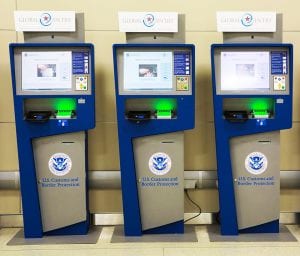
With Global Entry membership, getting through CBP is far easier. Avoid the very long line in the big hall waiting to be interviewed by a CBP officer. Members go to the Global Entry area at Customs, bypassing the long lines of travelers. There, you go to a Global Entry Portal and look into the facial recognition camera. An older kiosk may require scanning your passport photo and taking your fingerprints. A few seconds later, you’ll answer a few questions and be told by the portal to proceed. You then walk to the baggage claim area inside Customs. After you retrieve your luggage, you exit the area with it.
Alternatively, you may be able to use the Global Entry app on your smartphone as you walk through the Customs area, bypassing even the portal.
Using this process, I’m usually in the baggage claim area of Customs so fast that I beat my luggage to the carousel there.
Global Entry members automatically become members of TSA Pre-Check upon being approved for Global Entry membership.
The other Global Entry benefit to travelers who are members of Global Entry is TSA PreCheck membership, at no additional cost, to help you get through TSA security before flights in the U.S., whether domestic or international.
For CBP, the advantages of the Global Entry program are significant.
To become a Global Entry member, applicants fill out an extensive online questionnaire. They answer questions about themselves. They share detailed identity information. The CBP then uses this info to run a rigorous background check. If the applicant passes the background check, they must schedule an interview with a CBP officer. Only after the interview is complete can the applicant become a Global Entry member.
The Global Entry program separates the low-risk from the general public. It allows CBP to better concentrate its resources, making us safer.
By separating rigorously vetted low-risk travelers from other travelers as they reenter the country, CBP officers can focus on those who pose an unknown or high security risk. That helps CBP officers make fewer mistakes as they scrutinize those entering the U.S.

Global Entry uses automated, biometric portals, kiosks, and smartphone apps. It reduces the risk of human error in identification verification.
Moreover, the automated, biometric portals and kiosks, as well as the smartphone app used by CBP for Global Entry, reduce the risk of human error in identification verification of Global Entry members.
These systems aren’t necessarily error-free. Daniel Tanciar, Chief Innovation Officer at Pangiam, a company that applies computer vision and face recognition technology for government and industry use, stated before Congress that they are just less prone to error than well-trained CBP officers, according to studies. Facial recognition technology has been proven to reduce identification errors compared to trained observers.
Global Entry allows CBP to use its staff efficiently by minimizing staff used for screening of low security risk travelers.
In addition to reducing identification error rates, Global Entry permits CBP to use its staff and budget more efficiently, as they need only minimal staff to process Global Entry members returning to the U.S.
By suspending Global Entry, CBP needs more officers to reasonably process travelers because now everyone entering the U.S. needs to be interviewed by a CBP officer, even Global Entry members. During the partial government shutdown, with reduced budget funds available, DHS is supposed to be cutting costs, not increasing them.
Studies indicate that reducing screening for low-risk travelers increases detection accuracy. It allows for more screening of travelers with unknown and high security risks.
According to studies, including one by the Rand National Security Research Division, reducing security screening for low-risk travelers can increase detection accuracy by allowing more security screening resources to be used for travelers with unknown and high security risk. By suspending Global Entry, the identification error rate at the U.S. border will increase. CBP officers will have to process everyone, not just those of unknown or high security risk.
The suspension of Global Entry makes no sense. It will increase costs and the number of errors when travelers enter the country. This program has been carefully thought out.
READ ALSO:
Has the industry taken travel self-service too far?
Toddlers are vulnerable as recent FBI report shows airline sexual assaults soar

After many years working in corporate America as a chemical engineer, executive and eventually CFO of a multinational manufacturer, Ned founded a tech consulting company and later restarted NSL Photography, his photography business. Before entering the corporate world, Ned worked as a Public Health Engineer for the Philadelphia Department of Public Health. As a well known corporate, travel and wildlife photographer, Ned travels the world writing about travel and photography, as well as running photography workshops, seminars and photowalks. Visit Ned’s Photography Blog and Galleries.