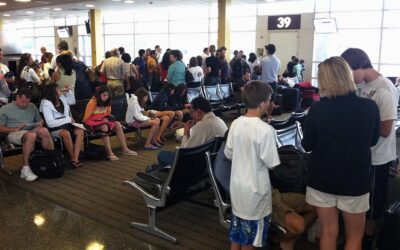

Photo by Kevin Woblick /Unsplash
Let’s be honest — if airlines could operate without humans, they would.
Already, there’s a move towards kiosks and apps rather than talking to humans at the airport, or even speaking with a person on the phone. It appears to normal flyers that a love-hate relationship now exists between airlines and travel agents.
If an airline could get ALL its tickets booked through its app or website, it would. Some of the cheapest (and most reviled) airlines in Europe and Asia, for example, only allow tickets to be booked online, and not even by traditional travel agents.
But over half of airline tickets are still booked by travel agencies. In 2025, the total travel agency sales exceeded $100 billion.
Now, in general, most airlines don’t pay basic commissions anymore.
When a booking is made through an agency’s computer system (GDS), there are per-segment costs. And the fact is that many major airlines, especially, enter into contracts to pay travel agencies, online and otherwise, as well as tour operators, for some tickets and routings. And this is NOT out of the goodness of their hearts.
Basically, airlines need help. During the recent winter disruption between TSA and bad weather, they certainly could. Even premium callers, including United Global Services, received messages like “If you booked your travel through a travel advisor, please contact them for faster assistance.”
(And talk to ANYONE who is a traditional travel agent; we all got regular calls from travelers begging for help with online bookings, which we cannot do, other than to book new tickets.)
Fixing the airlines’ mistakes.
 I spent the better part of a day at the last minute fixing a situation when a client had a waitlist for business, which cleared at about 5 a.m. from Miami. He and I were both asleep. Fifteen minutes later, United’s system or one of their agents canceled not only his business-class seat, but his original coach seat. Plus, the flight, after the World Baseball Classic, was sold out. (The reservationists were sympathetic. One said, “It shouldn’t have happened. It took all day for a cancellation to get him back on board.”)
Also, there is the marketing component. In a perfect world for airlines, they would like travelers to visit their own websites, because there would be no additional costs. But airlines do like the idea of agencies and tour operators “moving market share.” Translation: Suggesting the airline over the competition.
Some travelers are loyal only to one airline; others don’t care.
Many travelers have given up chasing miles for a better fare or other factors. So an agent’s opinion may matter (which airline has better service, lower price, easier connections, etc.).
As mentioned above, during rough times it helps airlines when an agent assists their clients in dealing with problems. Most travel agents who sell air have spent nights and weekends dealing with stranded passengers in 2026 — over issues like TSA lines, canceled flights, weather delays, etc. — and whatever commission an airline may give, none of them give anyone ANYTHING for rebooking help.
You MIGHT think that with all the recent problems airlines would be incentivizing agencies even more to book their tickets. But you’d think wrongly.
The same airlines that need travel agency help are often reducing their contracted commission.
This increases the fuel surcharge, which is unavailable to large companies with discount contracts and is not negotiable. (At the time of writing, the business class fuel surcharge from the US to Europe has been raised by American, United, and Delta from about $2100 to about $2800, and travel agents all expect $3000 soon.)
The same airlines are also becoming more and more proactive about charging agencies that book them penalties for myriad infractions. These range from reserving the same flight too many times — known as churning -— to typos on tickets. Since airlines pay a small amount per GDS booking, they understandably don’t want the privilege of holding space abused. But sometimes it’s necessary. Alaska Airlines recently charged us for such a booking when the client was dealing with a father entering hospice and couldn’t make a decision.
For example, United Airlines just charged us a significant amount for leaving out one digit in a four-digit code they want added to our tickets. And they refused to accept that it was an obvious typo, not forgetting the need for a code, during a horrible weather weekend with plenty of overtime work as an excuse to waive it.
Airlines are also warning agencies they will start charging for more booking violations, intentional or not. It’s hard to think of a single thing they are doing to additionally support agencies that book their flights, even a token payment for rebooking flights due to their errors or delays.
Getting rid of humans.
It’s quite possible airlines will figure out a model that lets them decide between AI and incentives for online booking, showing they can survive without humans. Or, if travel gets even more complicated, and/or consumers stay home, they may need all the incentives they can get to encourage agency business.
A reminder — travel agencies are generally on the side of the consumer. I’ll leave it open as to whether airlines are.
READ ALSO:
TSA needs much better disabled passengers rules now
Why an electronic ticket number still matters even without paper tickets

Janice Hough is a California-based travel agent a travel blogger and a part-time comedy writer. A frequent flier herself, she’s been doing battle with airlines, hotels, and other travel companies for over three decades. Besides writing for Travelers United, Janice has a humor blog at Leftcoastsportsbabe.com (Warning, the political and sports humor therein does not represent the views of anyone but herself.)