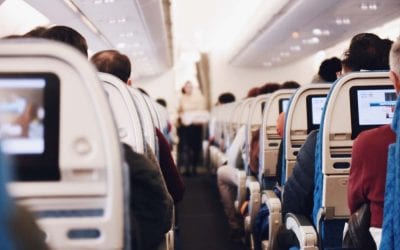
TSA has rules for disabled passengers while on their journey.
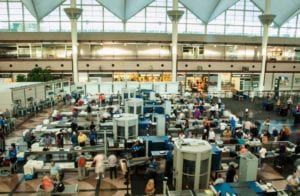 TSA (Transportation Security Administration) has definitive rules for helping and handling disabled passengers. Many are seniors. Unfortunately, too many times TSA TSOs (Transportation Security Officer) either don’t know their rules and procedures or don’t care about following them. I’ve seen and experienced this personally. And readers have described their problem encounters to me.
For disabled travelers or those who have serious acute or chronic medical conditions, getting help to go through TSA checkpoints is critical.
TSA was at its worst recently with a cancer patient with a disability needing a cane for mobility.
I know of a traveler who has terminal cancer and needs a cane to get around. She’s doing remarkably well, but standing is painful and her cane is crucial to assist her walking and prevent falling.
TSA states, “Inform the TSA officer of your ability to walk or stand independently before screening.” They further state,
“Aids: Walkers, crutches, walking canes or other mobility aids and devices, must undergo X-ray screening. A TSA officer will inspect the item if it cannot fit through the X-ray. Notify the TSA officer if you need to be immediately reunited with the device after it is screened by X-ray.”
Upon reaching the X-ray line at the TSA checkpoint, she informed the TSO that she had artificial hips and knees and that she would need her cane back immediately after being scanned. They took her cane immediately to X-ray her belongings. In violation of their rules, they didn’t return it until she had been fully processed. They forced her to struggle without it for more than 15 minutes. They even forced her to go to another security line for wanding.
TSA put that disabled traveler in jeopardy for no legitimate reason. They seriously endangered her. Fortunately, she got through okay.
This meant that:
1. They put her in serious danger of falling as she struggled to get to the other line without her cane.
2. Agents let her cane sit with her other belongings at the end of a line far from where she was being processed. They were in danger of theft.
3. They put her in significant, unnecessary pain by depriving her of the cane. They should have brought the scanning wand to the line she was in.
This 5’2”, 80-year-old cancer patient has chronic pain. TSA treated her carelessly with indifference and no empathy. They violated their own rules while screening her. Agents forced her to remove her shoes. They treated her like a terrorist. It should be noted that she had TSA PreCheck on her boarding pass because she’s a Global Entry member, the Trusted Traveler program that requires a significant Customs and Border Protection (CBP) background check.
After clearing her to fly, a TSO did help her return to the original line to retrieve her belongings, including her cane, but didn’t bring her shoes for her, forcing her to go back to the other line again.
It isn’t enough to depend on TSA to follow disabled passenger rules. Travelers must know the rules, too.
Maybe you had to be there to understand the problem fully. I hope that I’ve explained it well enough so that it’s clear that TSA needs to do better. At the same time, it’s also important for anyone with a medical condition or disability to know the rules themselves, so they can navigate TSA security checkpoints with a minimum of problems.
Here are the top rules to understand for air travelers going through TSA security checkpoints with a medical condition or disability. You can find a complete list of the rules at TSA’s website.
 Medications:
• Medications in solid form such as pills and capsules must go though standard X-ray screening at TSA security checkpoints. The medications are best stowed in their original containers, whether over-the-counter or prescription.
• Liquid medications in quantities in excess of the 3–1–1 Liquids Rule are permitted to be taken through TSA security. At the screening line, inform the TSA TSO that you have medically necessary liquids and/or medications and place them in a bin for separate screening. If you have accessories for them, such as freezer packs, pumps, syringes or IV bags, put them in the same bin. It’s essential that these medications be in their original containers and clearly marked. If not, there is a high likelihood that a TSO will want to open the containers and possibly test the liquids, which could compromise them. If X-ray, opening the container and/or testing the liquid would compromise them as medications, make sure that the TSO understands that. Additional screening may result, but your medications will remain usable.
• Ice packs for medication, unlike ice used for drinks or food, may be frozen, partly frozen or even thawed and stay within the TSA medication rules.
Mobility disabilities, aids and devices:
• If you have difficulty in walking or standing independently before or during screening, you need to inform the TSO at the top of the security line. You can ask a TSO for a chair to rest during screening and/or be screened while seated in a wheelchair or scooter. If you use a walking aid such as walkers, crutches or canes, while they have to be screened, you must inform the TSO at the top of the security line that you need to be reunited with the device immediately after it’s screened. If you ask, they are required to do so, even though sometimes they don’t.
• Be aware that TSOs may extensively test your aids or devices, which may take time, however, this is standard procedure with them.
Deaf or hard of hearing:
• If you are deaf or have hearing difficulties and need assistance during the screening process, inform the TSO at the top of the line.
• If you wear hearing aids or cochlear implants be aware that you are not required to remove them. If you’re told to remove them, inform the TSO that their rules state you may wear them as you proceed through security. If they set off any alarm during screening, you may be required to have additional screening. Before a recent flight I was told to remove my hearing aids for screening. They are delicate and I was concerned about damage. I refused, citing the rule. They backed off, but moments later a TSO demanded I give them my cellphone to test for explosives. I believe that test was retaliatory.
Respiratory equipment:
If you have a portable oxygen concentrator, inform the TSO if you can disconnect it during the screening process. Disconnect it, put it in for X-ray screening. If you can’t, TSA will screen it separately.
Travelers with a nebulizer, CPAP, BiPAP or APAP need special handling. Facemasks and tubing can generally remain in their case, but must go through X-ray screening. The liquids used for nebulizers are exempt from the 3–1–1 rule.
Many seniors are particularly vulnerable in the areas of disability and chronic illness. But there are many other travelers that TSA must also help. Too often, TSOs don’t know or follow their rules and provide the required assistance. Travelers must know them to help ensure they get the assistance they need and deserve.
READ ALSO:
Hotel room-rate lies — hiding mandatory hotel fees harms travelers.
How to get about $600 in flight delay compensation with EU rules.

After many years working in corporate America as a chemical engineer, executive and eventually CFO of a multinational manufacturer, Ned founded a tech consulting company and later restarted NSL Photography, his photography business. Before entering the corporate world, Ned worked as a Public Health Engineer for the Philadelphia Department of Public Health. As a well known corporate, travel and wildlife photographer, Ned travels the world writing about travel and photography, as well as running photography workshops, seminars and photowalks. Visit Ned’s Photography Blog and Galleries.