40 percent of global tourism is driven by demand to experience wildlife. Unfortunately, they don’t follow these 12 rules to photograph wildlife behavior.
 Here are 12 rules to photographing wildlife. The U.S. Fish and Wildlife Service estimates that in the U.S. alone, 73 million sightseers travel specifically to view wildlife annually. According to the Adventure Travel Trade Association (ATTA), up to 40 percent of global tourism is driven by the demand to experience wildlife. Globally, wildlife tourism, which allows travelers to see animals in their natural habitats, accounts for more than 200 million travelers annually.
Most of the time, wildlife tourists behave appropriately, but unfortunately, not everyone shows the proper respect for the animals and the people with whom they are traveling.
Wildlife tourist behavior in India’s tiger reserves has gotten so poor that the Indian Supreme Court has banned cellphone use in the reserves.
Wildlife tourism behavior has become so bad in India’s major tiger reserves that the Indian Supreme Court recently issued broad guidelines to curb disruptive behavior in the nation’s protected wildlife areas. A major new rule has been implemented, banning mobile phones in India’s tiger reserves, such as Ranthambhore National Park and Bandhavgarh National Park.
Park officials have been loudly complaining that it isn’t only the use of mobile phones to photograph the beautiful Bengal tigers, including trying to get close enough for selfies, but the incessant communication via mobile phones in the parks that is causing serious problems. For example, tiger sightings are being relayed between tourists, guides, and other drivers, causing vehicles to converge. That creates excessive noise, idling engines and too often blocked pathways used by the tigers and other animals. Not only are these tourists putting their own lives and those around them at risk, but they are also putting the tigers themselves under great stress.
In Greenland, a man in my landing group disrespected everyone in the group. He refused to follow instructions. He prevented most passengers on our ship from seeing the muskox there.
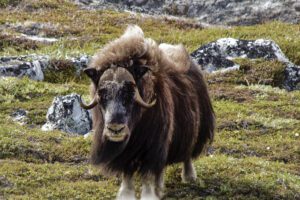
While reading about the problems in India, I was reminded of the problem behavior I encountered in Greenland some years back. We were cruising through Scoresby Sund, stopped at Renodde, and landed there by Zodiac. Renodde is well known for its musk ox population. Both male and female adults have long curved horns, average four to five feet high, and weigh from 330–880 pounds. Despite their size, muskox are extremely timid around humans.
Our guide reminded everyone in our group to be very quiet and communicate with hand signals. We hiked to the top of a distant ridge. We reminded everyone to stay low by crawling to the top of the ridge. With just the upper half of my hatted head over the ridge I saw a male muskox below us, less than 150 feet away, an extremely rare close-up. I waved to the others to crawl up and moved aside to give them a view, then crawled to another hidden position to photograph the muskox. I captured about a dozen photos when an unthinking member of the group at the top of the ridge stood upright, upset with his view, and panicked the muskox into a full gallop.
No one else from our ship was able to get closer than 2,000 feet from any muskox at Renodde. Our selfish, thoughtless group member ruined the day for everyone else.
Though the day was ruined, at least we were safe. Unfortunately, too many travelers viewing and photographing wildlife lack any kind of reasonable respect for the animals. That can be dangerous.
The news has many examples of wildlife tourist behavior so poor that it resulted in serious injury and, in some cases, loss of life.
A year ago, a 47-year-old man was gored by a bison at Yellowstone National Park when he got too close to it. Park officials caution visitors that wild animals can be very aggressive when people don’t respect their space. They recommend staying a minimum of 25 yards from any bison. He didn’t heed the warning.
Two years ago, a man was killed near Kachemak Bay State Park in Alaska by a female moose. He got too close to photographing her calves.
Earlier this month, two brothers were mauled by a grizzly bear at Yellowstone National Park. They got too close to the bear. In Japan, there has been a surge of fatal attacks by Asiatic black bears.
Many animals are dangerous, particularly if you get too close to them or their young.
I lead dozens of wildlife photowalks/hikes each year. To maximize the enjoyment of those photowalks, I require that everyone must respect each group member, the animals, and their habitat, for the animals’ long-term survival and the group’s safety.
My 12 wildlife photowalk/hike rules are based on respect for both fellow wildlife tourists and the animals they travel to see and photograph.
 Here are my 12 wildlife photowalk/hike rules:
1. Silence your cellphone – A loud or even low-volume ringing cellphone can startle wildlife near you, causing them to scurry and be under stress. It can substantially reduce wildlife viewing/photography opportunities for close-ups.
2. Garbage in, garbage out – Leave no trace of yourself in the wild. If you bring something in, take it out with you.
3. Leave no trace – It isn’t enough to leave nothing behind. Everyone needs to be aware of their surroundings at all times to ensure they don’t damage or disturb any wildlife habitat. Even small actions like removing branches near nests or clipping a few stalks of wildflowers to get a cleaner photo should never happen. It can be disruptive and harmful.
4. Go slow and quietly – Rapid and noisy movement in wildlife areas can and likely will cause animals to secret themselves and keep an extra distance from you, reducing your chances of a quality view or photograph.
5. Use whispers, or better yet, hand signals – Staying quiet while in the wild is critical if you want a chance at quality, close-up views of wildlife. Noise from humans or human activity, particularly when unexpected, will engender fear in most wildlife.
For safety, keep a safe distance from nests, young animals and all animal wildlife when in the wild.
6. Keep a distance away from all nests and young – For safety’s sake, stay away from nests and young animals. Parents are generally highly protective of their young. Large animals like lions, bison, moose, and bears are dangerous if you go near their young. Even some large birds like Canada geese should not be trifled with by approaching their goslings. They can take your finger off.
7. Wait your turn – It’s obnoxious to push people out of the way to get a better view for yourself. Everyone must share good viewing positions.
8. Give others a chance – This is the corollary to wait your turn. Those in front need to be sure that they rotate back to give others a chance to get a great view and a wonderful photograph.
9. Stay downwind – Many animals have a powerful sense of smell. Stay downwind to hide your presence.
10. Clothing and gear choices matter – Most birds, for example, have superb color vision due to their eye structure. Don’t wear bright and/or neon colors. Wear clothing that helps you blend into your surroundings. Hats, especially wide-brimmed ones, are helpful because they break up the human silhouette, making it more difficult for animals to know you’re a person.
11. Beware of fragile habitat – Never harm or stress habitat. A disturbed or damaged habitat can seriously interfere with the normal functioning of biological systems upon which the local wildlife depends for survival.

Common sense is always mandatory when in a wildlife area.
12. Common sense – When you’re in a wildlife area, you’re a guest. Use your common sense to be the best guest possible.
Following my rules when viewing/photographing wildlife will help you treat others and the animals respectfully and give you the best chance to see and photograph wildlife well.
(Image: Muskox at Renodde, Scoresby Sund, Greenland Copyright © 2023, NSL Photography. All Rights Reserved. All TDM and AI Training are Prohibited.)
READ ALSO:
EU airlines rules ban them from adding fuel surcharges to post ticket sales
Allow comparison of airline prices and ancillary fees across airlines

After many years working in corporate America as a chemical engineer, executive and eventually CFO of a multinational manufacturer, Ned founded a tech consulting company and later restarted NSL Photography, his photography business. Before entering the corporate world, Ned worked as a Public Health Engineer for the Philadelphia Department of Public Health. As a well known corporate, travel and wildlife photographer, Ned travels the world writing about travel and photography, as well as running photography workshops, seminars and photowalks. Visit Ned’s Photography Blog and Galleries.