Since 2002, passengers have paid TSA Aviation Security Checkpoint Fund whenever they pay for their airline tickets. Is it a tax or a user fee?
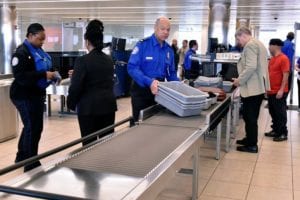
TSA Security Line
Originally set at $2.50 per segment, Congress raised the Aviation Security Checkpoint Fund (TTSA) Fee to $5.60 per one-way trip in 2013 as part of the Bipartisan Budget Act of 2013. About one-third of all revenue collected through this fee is diverted to the U.S. Treasury’s General Fund. Is this a tax or a user fee on aviation passengers?
TTSA screening grew to more than 900 million passengers by 2025, generating substantial revenue. Yet the number of checked bags was over 500 million. Around 30 percent, about $6 billion, goes to the TSA. As a result, while Security Fee revenue has increased, more than $1.6 billion is diverted to the General Fund alone.
That explains why not enough money goes to the TSA to keep everything operational. It suggests that if passengers are paying to support the TSA, more of the funds should go toward support and maintenance. There is enough money, but the general government funding is taking it.
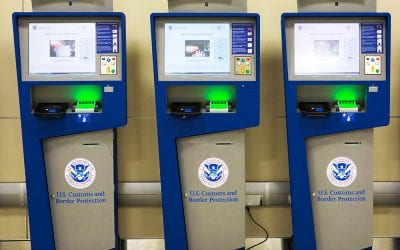
A total of $250 million annually is deposited into the Aviation Security Capital Fund (ASCF). The ASCF is responsible for funding and installing Passenger Screening and Checked Baggage Screening equipment. This allocation has meant that the $250,000,000 annual allocation has continued since 2002. A new bill containing $500,000,000 for explosive detection is under consideration.
Fees and Taxes Paid by Airline Passengers
Airline passengers incur various fees and taxes when departing from airports. Below is a breakdown of the primary charges:
Key Fees
| Fee Type | Amount | Description |
|---|---|---|
| September 11 Security Fee | $5.60 per one-way trip | A fee collected to enhance aviation security. |
| Round Trip Maximum | $11.20 | Maximum fee for a round trip. |
| Passenger Facility Charge | Up to $4.50 per flight segment | Charged by airports for facility improvements. |
Additional Information
- The September 11 Security Fee is applied to all domestic flights originating in the U.S.
- The Passenger Facility Charge varies by airport and is used for airport infrastructure projects.
These fees are typically included in the ticket price, but passengers should be aware of them as they contribute to the overall cost of air travel.
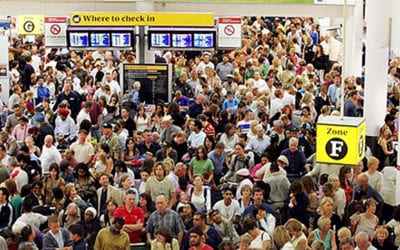
When TSA passenger screening equipment fails, it leads to longer queues at the security checkpoint. Passengers don’t get what they pay for, and don’t see the problems.
When Explosive Detection System (EDS) machines fail, passengers’ baggage quickly piles up in the bowels of the airport (unseen to the consumer). The breakdown of these machines becomes an unseen issue. Breakdown at carry-on baggage is easily seen.
The Washington Free Beacon has investigated this issue:
“The Transportation Security Administration (TSA) is not properly managing the maintenance of its airport screening equipment,” the Department of Homeland Security (DHS) inspector general audit said. “Specifically, TSA has not issued adequate policies and procedures to airports for carrying out equipment maintenance-related responsibilities. Because TSA does not adequately oversee equipment maintenance, it cannot be assured that routine preventive maintenance is performed or that equipment is repaired and ready for operational use.”
“Consequently, the safety of airline passengers and aircraft could be jeopardized,” they said.
TSA may use alternative measures to screen checked baggage in lieu of an EDS machine, which is responsible for that screening. Alternative measures are slow, resulting in hundreds of bags not making a flight or the airline holding the flight, causing lengthy delays. These delays, unseen by the public, have created problems for airlines, which are forced to pay fines and reunite misplaced baggage with travelers.
Most of these EDS failures go unseen by consumers and unreported by the media. All the consumer knows is that the airline failed to deliver their bag.
Passenger wait times stretched up to two hours in past breakdowns of explosive detection systems.
 In January 2024, Hilo Airport had two machines that failed. One is used to screen carry-on baggage, and the other is used to screen checked baggage. TSA recommended that passengers arrive at the airport more than two hours before scheduled flights. However, some travelers waited more than two hours. They missed their flights.
In larger airports, when TSA machines fail, wait times can exceed 3 hours. For example, Dallas Love Field Airport experienced failed EDS machines, leading to passengers waiting in long lines to check their baggage — and sometimes missing their flights.
In 2016, at Phoenix Sky Harbor International Airport, TSA’s EDS machines experienced a computer glitch that caused a continuous reboot cycle. These machines were unable to scan baggage, leading to over 3,000 bags missing their flights.
Southwest Airlines has been a major speaker at meetings where these “unseen” problems are discussed.
Many of TSA’s EDS machines were installed shortly after September 11, 2001. They are over 20 years old and well past their useful lifespan. Failures of these machines are not new occurrences and are growing over time.
Here is a system set in legislative language that will deal with modernization if the EDS machine has already been paid for by passengers. This makes the money collected clearly a fee rather than a tax.
SECTION 1. SHORT TITLE
This Act may be cited as the “Aviation Security Modernization Act”
SECTION 2. IMPROVING THE AVIATION SECURITY CAPITAL FUND
Section 44923(h) of title 49, United States Code, is amended by striking paragraph (1)
and inserting the following:(1) In General.—There is established within the Department of Homeland Security a fund to be known as the Aviation Security Capital Fund (in this subsection referred to as ‘the Fund’).
(2) Source of Funding. (A) In each of fiscal years 2004 through 2025 the first $250,000,000 derived from fees received under section 44940(a)(1) shall be available to be deposited in the Fund in paragraph (1). The Administrator of the Transportation Security Administration shall impose the fee authorized by section 44940(a)(1) so as to collect at least $250,000,000 in each of such fiscal years for deposit into the Fund; and
(B) In fiscal year 2026 and in each fiscal year thereafter the first $500,000,000 derived from fees received under section 44940(a)(1) shall be available to be deposited in the Fund under paragraph (1). The Administrator of the Transportation Security Administration shall impose the fee authorized by section 44940(a)(1) so as to collect at least $500,000,000 in each of such
fiscal years for deposit into the Fund.
(2) Grant Authority.—Amounts in the Fund shall be available to the Administrator of the Transportation Security Administration to make grants under this section.SECTION 3. ESTABLISHMENT OF THE AVIATION SECURITY CHECKPOINT
TECHNOLOGY FUNDSection 44923 of title 49, United States Code, is amended by—
(1) by redesignating subsection (i) as subsection (k); and
(2) by inserting after subsection (h) the following subsection:
(i) Aviation Security Checkpoint Technology Fund.—
(1) IN GENERAL.—There is established within the Department of Homeland Security a fund to be known as the Aviation Security Checkpoint Technology Fund (in this subsection referred to as the ‘ASCT Fund’). After the first $500,000,000 is deposited into the Aviation Security Capital Fund as authorized by 44923(h)(1), the next $250,000,000 from fees received under section 44940(a)(1) shall be available to be deposited in the ASCT Fund in fiscal year 2026 and in each fiscal year thereafter. The Administrator of the Transportation Security Administration shall impose the fee authorized by section 44940(a)(1) so as to collect not less than $250,000,000 in each of such fiscal years for deposit into the ASCT Fund. Amounts in the ASCT Fund shall be available until expended to the Administrator of the Transportation Security Administration to fund the procurement, deployment, and sustainment of aviation security checkpoint technology.
This change to the legislative language of the Aviation Security Checkpoint Fund makes the entire fee paid by consumers clearly a fee. Plus, it provides the entire security fee to the fund.

READ ALSO:
Learn to ask yourself this important early hotel check-in question
Death by selfies. Yes, they are real and happen regularly
Charlie Leocha is the President of Travelers United. He has been working in Washington, DC, for the past 14 years with Congress, the Department of Transportation, and industry stakeholders on travel issues. He was the first consumer representative to the Advisory Committee for Aviation Consumer Protections appointed by the Secretary of Transportation from 2012 through 2018.