The popularity of selfies for social media continues to grow. “Death by selfie” has killed hundreds due to highly risky behavior too often taken to make the “perfect” selfie for social media.
 As a professional photographer, I love a good selfie, though for me they are really self-portraits. I have many in my portfolio and have often had great fun making them, but I limit my selfies with respect. Respect for myself, for wildlife, for my surroundings and for those people around me, people I know and even strangers. The constant theme I see in selfie deaths is a lack of respect, particularly self-respect.
What is a selfie? Is there really a difference between selfies and self-portraits?
Selfies are generally thought to be spontaneous snapshots meant to be able to be quickly shared with friends and family on social media. Most of the time they are to document where one is, who they’re with, how they look, and what they’re doing.
Self-portraits are generally thought to be a planned, well thought-out image to show who one is and tell a story about them and often about what they’re doing. In other words, most people would say that selfies are a spur-of-the-moment decision, but self-portraits are purposeful.
When I look at the two definitions, I see an example of the idiom, “a distinction without a difference.”
I’ve talked with many social media influencers in recent years and I’ve read the accounts of countless selfie deaths and have come to the conclusion that their selfies were more likely heavily planned than spontaneous. Much of the time travelers have planned their journey to arrive at specific locations, often at specific times, to have great selfie opportunities. When they arrive is often carefully chosen to avoid security stopping them from getting to the precise location needed for the shot.
So far in 2026, there have been 17 documented selfie-deaths in the world, most in India, with one in the U.S.
At the White Cliffs in Russia’s Irkutsk region, a 24-year-old female student was hiking when she climbed onto a rocky ledge to take selfies and other photos. As she began to climb down, the ledge gave way. She plunged more than 330 feet, suffering catastrophic injuries. She died in the ambulance on her way to the hospital.
There is grim video footage made in India, at a theme park, of a man slipping from his seat on a park ride after his restraint gave way as he was attempting a selfie. In the video you can see the 24-year-old man first hitting a support pole, then plunging head-first about 15 feet. His face was covered in blood with one of his legs at a distressing angle. As he was being transferred to a second hospital for additional treatment, he died.
Earlier this year, in Bangladesh, a 32-year-old man stood on train tracks regularly carrying high-speed trains. He made his selfie, then sat on the tracks apparently to call a friend and send the selfie to them. He was killed instantly when hit by the train running at a very high speed.
These were deaths “by selfie.” Unfortunately, taking selfies for social media has cost hundreds of lives over time — too many lives.
A study by Australian researchers, published in 2023 in the Journal of Medical Internet Research, concludes that selfie-related deaths, especially from falls and drowning, are a serious public health issue. The researchers believe that the problem “requires a public health risk communication response.”
The researchers recommend the adoption of “no selfie zones,” physical barriers, signage, and providing information on dangerous locations popular for selfies by social media users. They state,
“Media reporting of selfie incidents should focus on preventive messaging rather than blame or warning.”
Nathalie Auger, MD, MSc, a physician epidemiologist at the University of Montreal Hospital Research Centre in Canada, has conducted extensive research in this area. According to Dr. Auger,
“Selfie-related mortality is a public health concern as these deaths affect people of all ages around the world, have been increasing, and could be prevented through better public education and awareness.”
To get life affirming validation, social media users are sometimes “forced to go to extremes.”
As reported in MedPage Today, Elias Aboujaoude, MD, clinical professor of psychiatry and behavioral sciences at Stanford Medicine in California, said that in the current age of social media in the lives of many across the globe, “likes, comments, and engagement are tied to users’ self-worth.” He continued, saying that to get life affirming validation, social media users are sometimes “forced to go to extremes.”
According to Dr. Aboujaoude,
“What is often lost in the discussion is the reason for which people will go to such extremes for that ultimate selfie. Social media encourages self-promotion and narcissistic tendencies, and the overuse of selfies can be seen as a manifestation of that.”
Based on my discussions with people who have taken my Travel Photography Photowalks, I must agree with Dr. Aboujaoude, as more and more I’m asked over and over again how to make travel selfies that will blow followers’ minds and shock them, rather than how to make great travel images that tell a story of where they’re visiting and the people who live there.
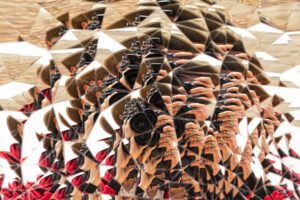
There’s nothing inherently wrong with making travel selfies. I’ve made countless self-portraits across the world while traveling, including the one above, that I shot in Atlanta’s High Museum of Art.
It’s time for tourists and others to use their commonsense and intelligence when making selfies.
Here are my four selfie rules of conduct and self preservation.
1. Have respect for others: It’s bad enough to put oneself in danger by selfie. It’s unconscionable to endanger others.
2. Have respect for wildlife: Respect for wildlife is two-fold. First, be careful not to be hurt by wildlife. Second, be careful not to hurt wildlife or their habitat so everyone can continue to enjoy seeing and studying them.
3. Have respect for your surroundings: Respect for your surroundings means that you must be careful not to damage the area in which you are located. Respect for the surrounding habitat and the rules set by those in authority who maintain the area and its qualities for locals and visitors alike is critical. Respect for the surroundings means to respect the locale so it remains in the condition in which you found it when you leave.
4. Have respect for yourself: Self-respect is essential to living successfully in this world. Each person wishing to create a selfie must be focused on their surroundings to prevent tripping, slipping and falling. It doesn’t matter if you’re near water or at a great height. Each person must have respect for any dangerous position that they’re in.
Dr. Auger concluded that “prevention strategies could focus on limiting travel or access to dangerous locations, raising awareness through social media about the risks associated with selfies, and encouraging other forms of safe social media behavior.”
I encourage every traveler to respect themselves and those with whom they’re traveling while attempting to capture their perfect shots of themselves and their destinations.
(Image: Self Portrait of Ned S. Levi, reflection in Untitled work (2010) of Anish Kapoor, British, born in India, 1954, Stainless steel concave dish at High Museum of Art.)
READ MORE:

After many years working in corporate America as a chemical engineer, executive and eventually CFO of a multinational manufacturer, Ned founded a tech consulting company and later restarted NSL Photography, his photography business. Before entering the corporate world, Ned worked as a Public Health Engineer for the Philadelphia Department of Public Health. As a well known corporate, travel and wildlife photographer, Ned travels the world writing about travel and photography, as well as running photography workshops, seminars and photowalks. Visit Ned’s Photography Blog and Galleries.