Use my 15 medication and medical device hacks so you’ll get through TSA airport security. Take all necessary medications and devices during your journey.
 A senior with a chronic condition should know these medication and medical device hacks. Note that if you’re flying, most medication rules domestically are unchanged. Some have been tweaked and at least one has been eliminated.
The Transportation Security Administration (TSA) appears to be enforcing its rules more rigorously, according to air travelers who have contacted me during the first weeks of the year.
I have 15 medication and medical device hacks for you to follow at TSA security checkpoints. Follow these hacks in airports across America, and follow a few if you’re flying internationally, to help you navigate through the checkpoints.
Bring reasonable quantities of any legal medicines, even liquid medications in excess of the 3-1-1 limits. Follow these rules when you fly in the U.S., but use common sense.
1. You can bring legal medications, prescription and over-the-counter, in pill or other solid form, plus liquids, aerosols, gels, and creams in reasonable quantities as long as they are announced, in the case of liquids, aerosols, gels, and creams, and all are screened. The medications may be in excess of 3–1–1 rule limitations if they’re packed separately from your 3–1–1 rule baggie.
Liquids needed for medical purposes may be brought aboard planes. You can take even non-medication items, such as saline solution for contact lenses, in reasonable quantities that exceed the 3–1–1 rule limitations. Liquid medications should always be in their original containers to verify authenticity.
Bring ice and gel packs to keep medications at their required temperature, even if partly or wholly defrosted.
 You can also travel with ice packs and gel packs to keep your medications at their required storage temperature. The ice packs and gel packs may be partially or fully defrosted during your journey, unlike other cooling packs, but they’ll be easier to pass through TSA checkpoints if they’re still frozen.
2. Medical devices like CPAP machines, nebulizers, etc. are permitted along with all their delivery and other parts and any liquids associated with them. If they contain or use Li-Ion batteries, please note that they can’t be checked in as checked luggage, but must be in a carry-on bag or your personal item. In the U.S., a CPAP machine does not count toward your carry-on luggage limit because they are considered a medical assistive device.
Syringes, when accompanied by an injectable medication, are allowed to be brought in reasonable quantities.
3. Bring enough medication for your entire journey, plus 5–7 extra days in case you’re delayed. That may mean you’ll need extra planning in order to get a pharmacy override to have enough medication for a long journey.
4. Before every trip, check with TSA to determine what you can and can’t bring concerning medications and medical devices. You never know when TSA will change its rules, so you must check prior to each trip on which you plan to fly.
Controlled substances should be packed carefully in their original container. Follow these medication and medical device hacks.
5. If you’re traveling with controlled substances, as I do for a chronic condition, always bring them in their original container with the original prescription label to mitigate or eliminate problems with TSA at the airport. In addition, for controlled substances, I always recommend bringing a letter from your physician explaining the need for the prescription, along with a copy of the prescription.
6. In the U.S., different states have different laws about prescription labeling and not all prescription medications are permitted in every state. A good rule of thumb is that every medication should be in its original container, with the prescription label on each container.
7. You can travel with medications in your checked luggage, carry-on bag and personal item. That said, I strongly recommend you pack all medications in your personal item. Unless too big to fit, pack all medical devices in your personal item, too, if you might need immediate access to them while in-flight.
You don’t have access to your checked luggage during the flight. If your medication is on board and needed in-flight, you’ll be out of luck. If your bag is lost or delayed upon arrival, you’ll need to purchase replacement medication, which may be difficult and time-consuming. In addition, with so many full flights these days, carry-on bags may be required to be gate checked. If they’re in that bag, you will lose access to your medications in-flight. Pack all medications in your personal item for safety’s sake.
8. It’s best if the name on the prescription matches the name on your government issued Real ID.
The liquid sanitizer exemption from the 3-1-1 rule has been rescinded.
9. The liquid sanitizer exemption from the 3–1–1 rule, put into place during the COVID pandemic, has been rescinded.
10. While medical marijuana and CBD products containing more than 0.3 percent of THC may be legal in your state, they aren’t permitted on planes in the U.S., since they’re illegal under federal law even if you have a prescription for them.
11. I recommend that you keep a detailed medication list with brand and generic names, dosages, plus prescribing doctor and pharmacy information. A letter and the prescription for all controlled substances should accompany the list. Keep both a print and digital copy of the information. If traveling internationally, have translations of the list in the languages of your destinations.
12. Keep your medication separate from your toiletries and other items. Organize them together in their own clear plastic bag(s) to facilitate TSA inspection. The easier you make it for TSA inspection, the less hassle they will give you.

Tell TSA agents if you have medication quantities exceeding the 3-1-1 limits and/or if you’re cooling medication with ice or gel packs.
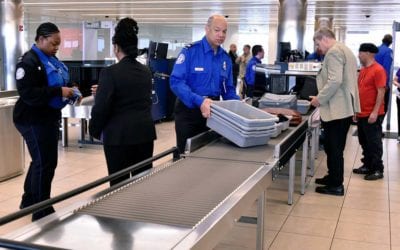
13. When you get to the TSA checkpoint, if you have any, announce to the TSA agent that you have necessary medication in excess of the 3–1–1 rule. Take your medication bag, including cooled medication bags, out of your luggage and place them in a bin for inspection. Inform TSA directly of any medications being cooled, as required. If you don’t pull them out and/or if they are scattered in your bag you can almost count on time consuming screening virtually every time.
14. Inform TSA of any internal or connected medical devices like pacemakers, insulin pumps, colostomy bags, knee replacements, hip replacements, etc., which could trigger an alarm. You want to be treated with dignity and avoid having external devices damaged, so don’t forget to inform TSA.
15. When traveling internationally, you have to remember that TSA rules only apply in the U.S. Many medications prescribed in the U.S. are banned in other countries. Many medications TSA allows in almost unlimited quantities may be highly restricted for quantities outside the U.S. Some countries require you to register in advance that you’re bringing specific medications into their country. Some countries require special documentation to enter with your medications. Before taking your medication on an international trip, you must do considerable research or you risk being refused entry or even jailed.
Following these 15 hacks will help you travel by air domestically smoothly and safely. They also manage your medications internationally. Heed them all, please.
READ ALSO:
Where you can buy things confiscated by TSA and lost by passengers
Will airlines get a free pass from the government?

After many years working in corporate America as a chemical engineer, executive and eventually CFO of a multinational manufacturer, Ned founded a tech consulting company and later restarted NSL Photography, his photography business. Before entering the corporate world, Ned worked as a Public Health Engineer for the Philadelphia Department of Public Health. As a well known corporate, travel and wildlife photographer, Ned travels the world writing about travel and photography, as well as running photography workshops, seminars and photowalks. Visit Ned’s Photography Blog and Galleries.