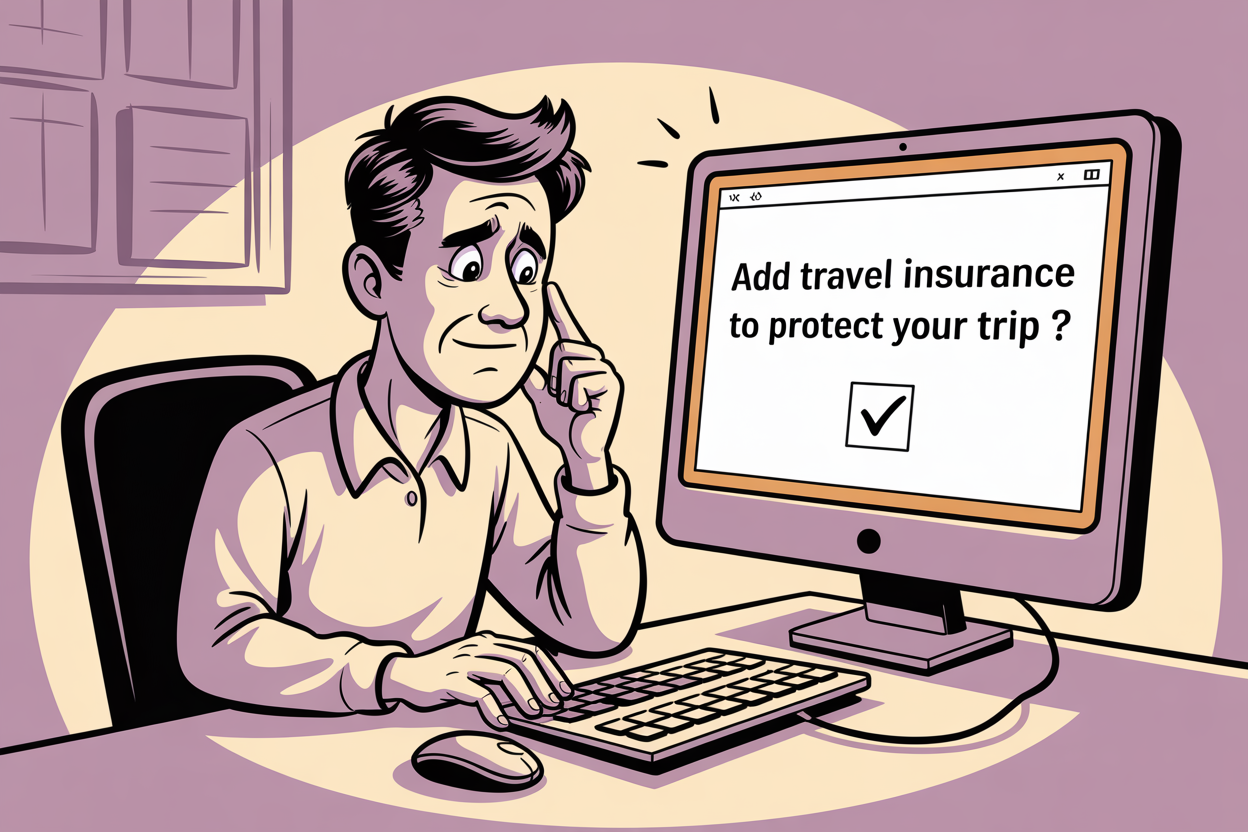
 You’re minutes away from confirming your dream vacation. You’ve selected a flight, hotel, and rental car. And then you see the question: “Add quick travel insurance to protect your trip for just $89?”
One click, and you’re covered. Right?
Maybe, maybe not.
That quick travel insurance you’re about to buy is what industry insiders call the fast-food version of coverage — cheap, quick, and likely to leave you hungry for real protection.
Almost 1 in 4 travelers have experienced a flight delay or cancellation, according to recent data from AirHelp. Yet many of those same travelers who thought they were covered by insurance discovered their checkout policies offered little more than expensive and illusory peace of mind.
“Checkout travel insurance is often cheap and incomplete, and we all know cutting corners on safety is risky,” says Danielle Graham, sales manager for Global Rescue. “Most of these policies don’t include essentials like medical evacuation or security extraction.”
Research by Yonder Travel Insurance found that travel supplier policies cover 15 to 30 percent fewer cancellation reasons, offer 10 to 33 percent less medical evacuation coverage, and provide about three times less missed-connection protection than retail policies.
And that’s the problem. The U.S. travel insurance market reached $8 billion in 2023 and is predicted to hit $15 billion by 2030, but a growing chunk of those sales comes from add-on policies that don’t always protect you.
The markup nobody talks about
 Here’s what travel companies don’t want you to know: those checkout policies are massive profit centers. Patrick Caruso, an independent insurance agent, recently quoted a client $34 for standalone coverage that would have cost $89 through an airline’s checkout process.
“The markup on checkout policies is brutal because the booking platform takes its cut too,” Caruso said. “When I price standalone travel insurance for my clients, I’m seeing 40 to 60 percent savings for equivalent coverage.”
The math gets worse when you realize you’re paying more for less.
“And those plans almost never cover the big things that really matter, like medical emergencies, evacuations, lost luggage, or long delays,” she adds.
Jackie Mondelli, chief marketing officer of Squaremouth, sees this constantly: “These checkout travel insurance policies may appear at checkout even for fully refundable bookings, where trip cancellation coverage is not necessary.”
The medical coverage mirage
That’s not all. Neville Mehra, co-founder of the travel insurance platform Genki, says there are other consequences of buying add-on insurance at checkout. But you may not find out about them until you have a health problem while you’re on the road.
“Ending up in a hospital in a foreign country — there’s really no limit to how much it might cost in the case of a severe accident or illness,” Mehra said. “We’ve seen cases even in countries that are considered budget destinations like Mexico and Thailand where travelers have ended up in the hospital with bills ranging from $30,000 to $100,000 for inpatient surgeries for things like appendicitis.”
Many checkout policies either exclude medical coverage entirely or cap it at laughably low amounts, according to experts.
Max Coupland, CEO of Insuranceopedia, warns that travelers often discover these gaps too late.
“Checkout insurance often has very narrow definitions of covered reasons for cancellation, things like illness or severe weather, while excluding common scenarios such as work-related cancellations, pre-existing medical conditions, or strikes,” Coupland says.
The adventure traveler’s nightmare
For anything beyond basic travel, checkout policies become virtually useless. Whitman of Rise & Shield points to a common scenario that leaves adventurous travelers exposed.
“Most checkout policies exclude mountaineering or cap trekking at 2,000 to 3,000 meters, so altitude illness or a heli-evac isn’t covered,” Whitman said. “Here’s my rule of thumb: if the activity or altitude isn’t spelled out, you’re not covered.”
Professional photographer Jeffrey Wang, who logs over 100,000 miles annually with expensive equipment, learned to avoid checkout options entirely.
“These policies are often disappointingly narrow and designed to protect the trip cost for casual travelers,” Wang says. “Not the specialized gear or creative investment that defines my livelihood.”
When checkout coverage works
But checkout insurance isn’t always worthless. For simple domestic trips or short weekend getaways, it can provide basic protection at a reasonable price.
“For simple, low-cost trips, checkout insurance may be sufficient,” Coupland said. “Bigger, international, or nonrefundable trips, shop for a standalone policy for broader protection.”
Some travel companies do offer legitimate value. EF Go Ahead Tours provides “cancel for any reason” policies for $75 on trips that can cost thousands per traveler. When you’re spending serious money, that level of flexibility becomes worthwhile.
But you have to do your due diligence before clicking the “buy” button. Scott Fleming, president of Aon Affinity Travel Practice, notes that while checkout policies offer convenience and customization for specific trip types, “we recommend that consumers always review their coverage to ensure it meets their individual needs.”
The smart shopper’s strategy: buy or wait?
The experts are nearly unanimous: shop carefully for standalone coverage. Very carefully.
“I usually tell clients that they should shop around to find a plan that is best suited for them,” said John Cook, president of QuoteWright.com. “The travel plans at checkout are generally stripped-down plans that are designed to hit a specific price point that maximizes sales rather than benefits to the traveler.”
Suzanne Morrow, CEO of InsureMyTrip, echoes this advice.
“Independent, third-party travel insurance providers typically offer broader protection, often at a more competitive price,” she says.
The average cost of comprehensive travel insurance runs 5 to 6 percent of your trip costs, according to recent analysis. For a $7,000 trip, that’s roughly $350 to $420 — often less than what you’d pay for multiple checkout policies that cover only portions of your journey.
Travel guide Lahcen Ait-Hami has watched this play out with his clients in Morocco. “Travelers who purchased a separate policy usually felt more secure, especially when their trip involved multiple stops, longer stays, or activities like camping in the Sahara. The separate policy is more protective and easier to comprehend.”
The coverage that counts
When shopping for standalone policies, focus on what really matters.
“It’s always a good idea to review the terms and conditions to make sure the benefits align with the specific travel itinerary,” says Rhonda Abedsalam, vice president of travel insurance at AXA Partners US.
Look for policies that include:
- Emergency medical and evacuation coverage (especially crucial internationally)
- Trip cancellation for a broad range of reasons
- Coverage that begins when you purchase the policy
- Cash payouts, not vouchers or credits
- 24/7 assistance and support
Steve Johnson, chief product officer at Backpack Insurance, says you have to make sure you get the real deal — not some stripped-down, overpriced version of insurance.
“Ask yourself: Is it complete travel insurance, or is it only flight insurance?” he says. “Is it a comprehensive policy, or does it only cover the traveler’s bags? Does it only cover travel purchases made using a specific credit card?”
Don’t forget the annual option
For frequent travelers, annual policies can offer the best value. Diana Steele, who works for a university in Cleveland, says her $275 annual policy has saved her a lot of money.
“Each year, I’ve had a mishap — urgent care visit, canceled flight, emergency dental work — that cost me at least slightly more than the insurance itself,” she says. “My last trip, to Spain in June, had a canceled return flight that left me stranded overnight in Madrid. I spent 250 euros to remain in the hotel. By the following Thursday, my claim was paid in full.”

What to do when you book your trip
One thing is clear: When you’re booking your trip, you have a decision to make about travel insurance.
“Buy your travel insurance when you book your trip,” advises Daniel Durazo, a spokesman for Allianz Partners. “If you wait to buy insurance, you may not be covered if an event happens between when you book and when you purchase the insurance.”
The question is, where should you buy?
The best advice is to shop around. Sure, it takes a few extra minutes. But would you buy car insurance from a car dealer without comparing rates? Would you purchase homeowner’s insurance from your real estate agent just because it’s convenient?
The travel industry has trained us to expect convenience at every step, but some conveniences might cost more than they’re worth. That checkout insurance box isn’t necessarily there to protect you, but it will always protect the travel company’s bottom line.
READ ALSO:
Four years ago, 73 percent of sick plane passengers would fly; flight changes too costly — today?
TSA needs much better disabled passengers rules now

Christopher Elliott is the founder of Elliott Advocacy, a 501(c)(3) nonprofit organization that empowers consumers to solve their problems and helps those who can’t. He’s the author of numerous books on consumer advocacy and writes three nationally syndicated columns. He also publishes the Elliott Report, a news site for consumers, and Elliott Confidential, a critically acclaimed newsletter about customer service. If you have a consumer problem you can’t solve, contact him directly through his advocacy website. You can also follow him on X, Facebook, and LinkedIn, or sign up for his daily newsletter.