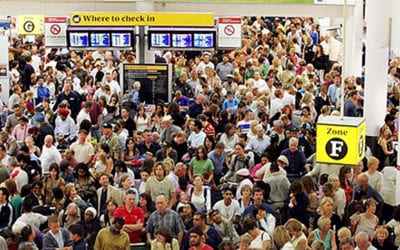
Avoid airline myths. Jay Sorensen calls on airlines to simplify policies and rebuild customer trust.

Photo by Kevin Woblick/Unsplash
Jay Sorensen Busts 8 Airline Myths, takes direct aim at widely accepted practices such as upgrade auctions, complex fare-change rules, inconsistent baggage policies, and the belief that airlines are destined to operate with chronically low margins. Many of these ideas persist not because they are effective, but because they have become airline myths embedded in industry culture.
Written for business travelers and airline insiders, this report offers useful information for consumers as well. We have excerpted the consumer portions of this report. Download the entire report by clicking here: https://ideaworkscompany.com/reports/.
Among the report’s observations:
- NEGLECTING NON-TECH-SAVVY CUSTOMERS IS CRUEL
- WE ARE LOSING OUR INTEGRITY AS AN INDUSTRY
- AIRLINE WEBSITES SHOULD INSPIRE TRAVEL
- “Seamless travel” remains more of a marketing slogan than an operational reality.
- Upgrade auctions may generate revenue, but can dilute the integrity of premium pricing.
- Well-managed airlines across regions and business models consistently achieve strong operating margins.
- Loyalty programs remain fundamentally tied to airline performance despite growing credit card revenue.
- Carry-on congestion and gate chaos are policy-driven problems, not unavoidable outcomes.
The analysis also highlights operational issues that directly affect the passenger experience, including baggage policies that create gate congestion, digital platforms that emphasize transactions rather than travel inspiration, and the lack of empathy for non-tech-savvy travelers as airlines expand automation. Addressing these issues, the report says, can simultaneously improve customer satisfaction and financial performance.
FLYING AGAINST THE STATUS QUO
President Ronald Reagan once defined “status quo” as “a Latin name for the mess that we’re in.”
Some folks are genetically wired to be agents of change and to have an immediate aversion to, “Well, we’ve always done it that way.” I count myself as a fellow traveler in this league. The trouble is… it often causes trouble. But I’m also an optimist, and believe flying against the status quo creates opportunity. In the airline business that equals more revenue and happier customers.
CRAZY-STUPID COMPLEX FARE CHANGE RULES ARE…STUPID
In a galaxy far, far away, the rules associated with booking changes were silly simple. Then in 1985 American Airlines introduced the Ultimate Super Saver fare. Bob Crandall and his team announced discounts of 70 percent or more off full-fare prices. I remember this day very well, as I was the Manager of Pricing at Midwest Express Airlines. The move changed everything for the US airline industry, and eventually for the world. Of course, it was rapidly matched by every US airline, and their share prices went into a tailspin.
But something very new appeared: 25 percent of the fare would be non-refundable. Travel agents predicted bedlam and chaos. More than 40 years later, that assessment remains correct for many consumers. Over time, the non-refundable portion would become 100 percent and the ability to make changes would be severely crimped by big fees and restrictions.
CARRY-ON FEES CAN STOP THE CHAOS
 The conversion from free to fee in 2008 was quick and messy. From May through November of that year, every major US airline (Alaska Airlines would follow in April 2009) implemented a $15 fee for the first checked bag. From that point forward, the whole world’s airline industry eventually joined in.
A RUINOUS POLICY
We have all heard at the gate, “Ladies and gentlemen, today’s flight is full and we are looking for volunteers to check their overhead bags free of charge.” What this announcement truly communicates is this: You are a fool if you pay to check your bags. It makes honest passengers feel like idiots.
I’ve worked with client airlines in the Americas and Europe to fix this problem. The cause is the disconnect between the commercial and airport operations departments. The solution requires data collection, revenue analysis, new procedures, more staffing, and a good amount of diplomacy. The results of my work have been profound, with smoother, faster operations, happier customers, and increased revenue.
Adding larger bins is an expensive choice, and merely increases the quantity and size of bags brought to the gate. The best resolution includes charging for overhead bags, along with other charges tailored to each carrier.
Checking bags at the gate only leads to spiraling problems and lost revenue.
AIRLINE WEBSITES SHOULD INSPIRE TRAVEL
Kudos to the airline industry for creating powerful booking engines. These have grown beyond the simplicity of selling a single fare to the retailing of a buffet of choices.
The booking path today includes branded fares, seat assignments, prepayment for baggage, meal selection, hotel and car rental bookings, and much more. The list of transactions continues to grow, but our skills as master retailers do not.
Consumers arrive, pick and click what they want, and then depart the store. It’s similar to selling photo books on the South Rim of the Grand Canyon and forgetting to tell people there’s a giant panorama to view. We are engaged in the beauty of flying people all over the globe. And the best we can do is focus on a giant “from/to” booking box as the first thing seen on the home page? Very uninspiring.
We will forever spill business to hotels, online travel agents, and media sites until we become sources of travel inspiration. I can’t identify a single airline website as representing a best practice.
NEGLECTING NON-TECH-SAVVY CUSTOMERS IS CRUEL
I arrive plenty early at the airport before departure to observe customer experiences and airline policies in action. This includes chatting with airline staff. After introducing myself as someone in the airline industry, they appreciate that someone is taking an interest in their jobs. On many occasions, I’m told, “No one in management talks to us.” I learn more by listening than talking.
Last year, I watched a middle-aged couple attempting to use a check-in kiosk on a trip through Reno-Tahoe International Airport. There was no airline staff around to help them. It was clear they were clueless about the process. They pushed buttons on the screen, looked around for help, and shook their heads in frustration.
Perhaps they saved for years for a trip to visit a son or daughter and had happy anticipation for their first airline trip in decades. And here they were, embarrassed over the inability to get through the first step. Finally, a passenger using an adjacent kiosk stopped to help. This silent drama is repeated constantly all over the world.
It’s easy for a well-intentioned group in a conference room at airline headquarters to dream up the next big cost-saving, self-service, seamless, and touchless initiative. But a portion of the world’s population will struggle with a process that’s all-tech, without any opportunity for human assistance.
Be sympathetic and always include a method for some customers to get extra help.

WE ARE LOSING OUR INTEGRITY AS AN INDUSTRY
There was a time when saying you worked for an airline was a source of genuine pride. In many ways, that pride still exists, and our industry continues to carry the mystique of air travel. But it has been eroded ‒ largely by our own doing.
A good friend of mine, Michael Smith, once remarked that whenever he told people he worked for British Airways, he heard one of two responses: “How can I get an upgrade?” or “You lost my bags.” Those comments may seem casual, even humorous, but they are symbolic of the deeper problems facing our industry.
The loss of pride can be traced to accumulated moments when our commitment to ethics and empathy slipped. This report offers ample examples. We label services as seamless when the reality falls short. We claim change fees have been eliminated . . . while they persist in different forms. We tolerate carry-on chaos by sending mixed messages, waiving fees at the gate while charging others. Each shortcut taken to reduce costs or boost revenue chips away at trust. And every time it happens, the “respect meter” drops a little lower.
This is not a call for nostalgia. Ignoring the erosion of pride has become the status quo, which you read earlier is “a Latin name for the mess we’re in.” Pride in our industry is more than sentiment; it is a barometer of how well we serve the public.
I encourage you to be the person who causes good trouble. The remarkable result? Greater trust, happier customers, and, ultimately, stronger revenue.
READ ALSO:
How airlines often penalize early birds
Has the industry taken travel self-service too far?

Charlie Leocha is the President of Travelers United. He has been working in Washington, DC, for the past 14 years with Congress, the Department of Transportation, and industry stakeholders on travel issues. He was the first consumer representative to the Advisory Committee for Aviation Consumer Protections appointed by the Secretary of Transportation from 2012 through 2018.