 According to SITA, a multinational information technology company serving the air transportation industry, in the last fully reported year in the U.S., the airlines mishandled 6.3 checked bags per thousand passengers. Theft preventatives are more important than ever.
Mishandled bags are luggage that’s been lost, stolen, missing or delayed. This month airlines raised their checked luggage fees, higher than ever. The airlines’ luggage fees are now commonly charged at $45 to $50 for the first bag for domestic flights in the U.S.
Mishandled bags and sizeable luggage fees are two of the main reasons that air travelers are flying solely with carry-ons, rather than checked luggage.
Air travelers assume that their carry-on luggage and personal items are safe once on they’ve stowed them on their flight. While they are likely safer than checked luggage, their safety is certainly not 100 percent. There are no statistics on in-flight theft or post-flight stolen carry-on bags, but more than a few thefts are reported frequently.
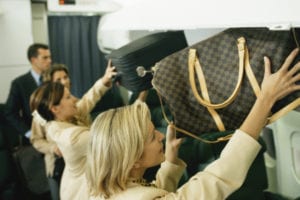
Over the years, I’ve had many discussions with flight crew while aloft. They’ve warned me about the lack of safety of passengers’ valuables stowed in the overhead bins and their in-flight vulnerability while passengers sleep, stretch away from their seats, or are at the lavatory. Their advice is not to place passports, wallets, jewelry, and small electronics in carry-ons stowed in the overhead bin, particularly if they are not within easy view. They strongly advise keeping those items in one’s personal item that’s placed under the seat in front of them.
Flight crews always talk theft prevention, because recovery is difficult and rarely occurs.
 On a recent flight, I asked a flight attendant if she ever encountered a passengers taking another passenger’s carry-on and making a quick exit from the plane. She told me that while it’s rare, she’s had several cases in recent years. She explained that some passengers end up using overhead bin space out of sight, well in front of their seat. Those highly susceptible bags are sometimes stolen or mistakenly taken, and the passenger who took the bag is generally off the plane by the time the owner finds out it’s gone.
While the airlines accept no liability for carry-on bag losses, they will help locate your missing carry-on bag. If your carry-on is missing, immediately report it to the flight crew. If the bag was taken by mistake, there will likely be a straggler bag. Usually, the bag owner is identified, and the airline can help exchange bags so the missing bag can be returned to the owner. If there is no straggler bag, then passengers must report the missing bag to the airline’s baggage claim before leaving the airport. Unfortunately, unless there was a mistake, it’s unlikely your bag will be recovered.
The flight crews’ advice about theft prevention is really the best action air travelers can take.
Here are my nine top carry-on theft preventatives.
• If you can’t afford to lose it, don’t take it when you travel. Leave it at home!
• Remove old airline luggage tags before gate checking your luggage.
If your carry-on had to be gate checked on your last flight, remove the gate check tag from your bag in case you have to gate check it again. You don’t want to take a chance of baggage handlers’ confusion with a second tag on your bag.
• Pack anything valuable in your personal item, if you can, not your carry-on.
Airlines don’t accept liability for carry-ons and personal items and their belongings brought into your plane’s cabin. Items packed in your personal item and stowed under the seat in front of you are more secure than packed in your carry-on, stored in the overhead bin.
• Lock your carry-on.
Lock your carry-ons. There are plenty of airline passengers who will pilfer items from carry-ons in the overhead bins, if given a chance. If you lock your luggage, thieves are more likely to try easier, unlocked targets. Also, when your luggage is locked, if it falls or drops during transport, it’s more likely to remained closed, keeping your belongings intact.
If your carry-on bag in the overhead bin is stolen or taken by mistake, an Apple AirTag can help you locate it for retrieval.
• Put an Apple AirTag or other tracker in every piece of luggage you bring on a trip.
The Apple AirTag is the best luggage-tracking tool available for any traveler. I recommend placing an AirTag in every piece of luggage you’re using for any journey. But I also use air tags on carry-ons and personal items. I’ve been using them in my bags for years.
• Use colored tags or other durable methods to make your bags more recognizable.
Make checked luggage stand out from everyone else’s. It makes identification at the carousel easier and prevents theft. The same is true for carry-on luggage and personal items. Just like checked bags, many carry-ons look like others’.
I put a colored ID tag on each handle of my carry-on. The ribbons are doubled on my backpack, which is my personal item. I also tie a colorful ribbon on each handle of my carry-on and on my backpack. You should make the appearance of our carry-on items stand out for easy identification. Stow your roller carry-on with the top handle sticking out. I place a large colored, embroidered tag with my name on it to set it apart from everyone else’s carry-on.

Where you stow your carry-on and personal item matters.
• Stow your carry-on in an overhead bin location as close to you as possible.
The closer your bag is stowed in proximity to your seat the better. You can keep an eye on it to prevent in-flight pilfering and bag theft.
• Stow your personal item under the seat in front of you.
If you have valuables and breakables with you, and you have packed them in your personal item, be sure to keep it with you. Stow it under the seat in front of you for take-off and landing. It will take away from your legroom at those times, but you can move it back under your legs during the flight to give you max legroom.
• Keep travel documents, cash, and your wallet on your person during your flight.
Keep your essentials with you at all times during the flight. Keep your wallet, cash, passport, and other identification with you. Even when you head to the lavatory, take it.
These prevention rules aren’t fool-proof, but they can go a long way to help you prevent the in-flight theft of your personal belongings. I’ve been using them for years.
READ ALSO:
Using less mobile data when you travel. FAA finding on O’Hare AA/United scheduling spat.
Will the Iran war claim an airline because of fuel costs?

After many years working in corporate America as a chemical engineer, executive and eventually CFO of a multinational manufacturer, Ned founded a tech consulting company and later restarted NSL Photography, his photography business. Before entering the corporate world, Ned worked as a Public Health Engineer for the Philadelphia Department of Public Health. As a well known corporate, travel and wildlife photographer, Ned travels the world writing about travel and photography, as well as running photography workshops, seminars and photowalks. Visit Ned’s Photography Blog and Galleries.