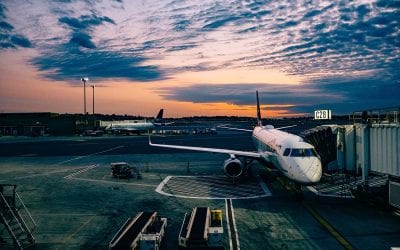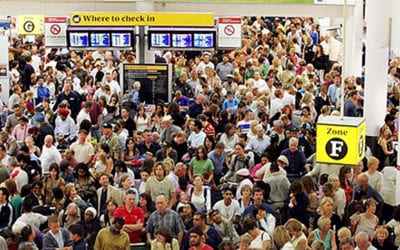
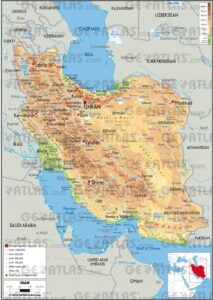
 Because of the Iranian War, TSA security checkpoint lines are long during Spring Break, and flights are being canceled to the Middle East.
I have been talking with travel agents whose people are stuck in the Middle East because of the Iranian War. I know this article is disjointed and deals with war at its worst, but the word has to get out.
Thousands of Americans had nowhere to go until the US began a paltry number of evacuation flights, except for overbooked flights from Cairo Airport in Egypt. Another functioning airport is Oman. Today, it is a real evacuation hub. My efforts have been to find ways home for stranded passengers.
I suggested that the tens of thousands of stranded civilians go to the open airports and beg to be put on flights to Europe or the US. They were all ready to go on standby. But many had families and needed more seats. Eventually, the standby passengers heard from the State Department that they should not rely on the US government to evacuate them. Many decided to escape any way they could. The final cost may be almost ten thousand dollars.
 The President, after three days of the war and bombing, said that those staying should depart from 14 countries in the region. It is still chaos. Contingencies are not figured in anticipation of changes on the ground.
If they have flights to the Middle East, they need to cancel them, as US carriers have stopped service to the region.
The most affected portion of the American budget is the price of gas. Keep the tank filled, even at inflated prices.
In the Middle East
The war’s impact on aviation has forced travelers in the Middle East to embark on more adventurous journeys home. An organizer firm set up evacuation flights from Muscat, according to people stuck in Abu Dhabi. They are traveling overland from Dubai to Oman. They then catch a flight out of the capital. From Doha and Bahrain, they take ground transportation to Saudi Arabia.
According to the New York Times, for weeks there had been talk of the possibility of war if diplomacy failed. The Trump administration should have given sufficient warning to its embassies and instructed them to plan for the departure of both its staff members and civilians, in accordance with established procedures.
Misidentification of civilian aircraft and drones is adding to fears about flights into and out of the Middle East region’s airports.
The NYT had a specific article about the Iranian government keeping quiet about the extent of the bombing. The Iranian and the US governments are beginning to ask questions about which types of workers should be considered members of the Islamic Republic. Are court people and policemen to be considered Islamic Republic members? Or not?
Airlines
Air service is slightly improving, however. On the day after the attacks, about 65 percent of flights departing the Middle East were canceled. On Monday (a week ago), the number of cancellations fell to 37 percent, or around 1,226 flights. Yesterday, the mood on Wall Street was even better.
Frankly, airlines are not used to dodging drones.
Closer to home are the problems of airlines that depend on cheap oil and aviation fuel. Experts say Spirit Airlines, Frontier Airlines, and JetBlue are most at risk.
At home

The Dubai Desert
Transportation Security Administration (TSA) officers are preparing for a missed paycheck this weekend (March 14 and 15), due to the continuing partial government shutdown. Fears are mounting that staffing issues could persist or get worse.
On Monday (this week), travelers at William P. Hobby Airport in Houston continued to endure hours-long waits for security that reached a peak of more than three hours on Sunday. Reuters reported that the waits averaged three hours at standard checkpoints by midday Monday. By late afternoon, those lines had dropped — to two hours. The airport asked travelers to arrive four hours ahead of their flights on (this) Monday.
U.S. Passengers
Just when we don’t have to worry about Global Entry and PreCheck, we have to take domestic policy into account. There is a solution, the Mobile Passport Center (MPC), but it isn’t available at all airports yet.
The Washington Post describes it this way: Unlike Global Entry or TSA PreCheck, MPC doesn’t require preapproval or an application process. You can install the smartphone app in seconds. To be eligible for MPC, you must be a U.S. citizen, a lawful permanent resident, a Canadian B1/B2 citizen visitor or a returning Visa Waiver Program traveler with approved Electronic System for Travel Authorization. Individual travelers and families of up to 12 can be processed together on the same app. MPC is not a foolproof solution, however. Travelers have complained of spotty availability of MPC lanes, and still having to wait in long lines even where it is available.
Russia
This country is sitting pretty for now, as oil prices continue to climb.

READ ALSO:
Know the DOT real rules for best compensation when you are bumped
This is the most dangerous activity when you travel

Charlie Leocha is the President of Travelers United. He has been working in Washington, DC, for the past 14 years with Congress, the Department of Transportation, and industry stakeholders on travel issues. He was the first consumer representative to the Advisory Committee for Aviation Consumer Protections appointed by the Secretary of Transportation from 2012 through 2018.