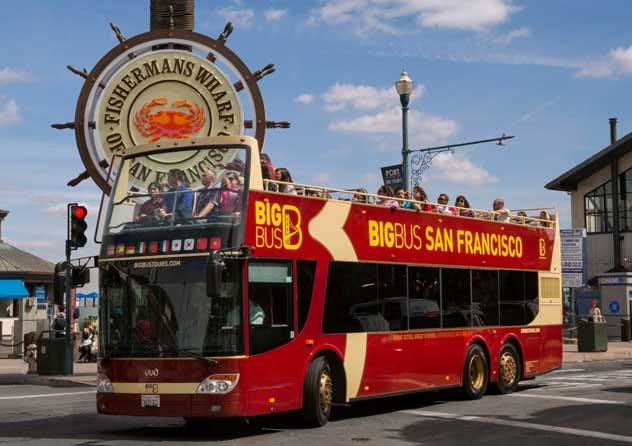
Sometimes, they may be a regular tour bus; other times, they are a hop-on-hop-off bus. Most lower levels are air-conditioned.
A hop-on-hop-off bus offers a way to see the major sights of a city effortlessly in rain or shine. I used to feel sorry for the tourists who packed onto these buses. Now, I have a different idea. After decades of sightseeing and traveling, I’ve learned a bit.
A friend, about a dozen years older than me, always used a hop-on-hop-off bus.
Whenever he arrived in a city he did not know, he took these buses to get the lay of the land. It was the first time I had heard about this approach.
My friend traveled often to very exotic destinations. He had been to Argentina, Vietnam, Columbia, Hong Kong, and across Europe and the United States. If these buses helped him I assumed they would help me as well. Plus, he learned a lot about history during the tour.
A hop-on-hop-off bus provides an authentic experience.
I’ve traveled to Berlin, where the bus took me to the Brandenburg Gate, Museum Island, and Checkpoint Charlie. In Paris, I saw Notre Dame, cruised the Left Bank, and passed the Louvre and the Eiffel Tower. While taking a bus in Rome, I circled the Colosseum, found where I could see St. Peter in Chains, and stopped at St. Peter’s Cathedral. In London, these tour buses took me to the Tower of London, St. Paul’s, and Trafalgar Square.
These were safe ways to see the sites in Argentina after being warned about taking taxis. We glided past Recoleta Cemetery and around the city. We discovered the Teatro Colón, La Boca, and the Puerto Madero. In New Delhi, we experienced the sights, sounds, and scents of one of India’s most diverse cities on this super saver bus tour, all aboard an air-conditioned bus. In Hong Kong, we visited the Man Mo Temple and Tai Kwun and bought a combination ticket for the Peak Tram.
Some buses let me get off at each stop and catch a later one. Other times, I used these “authentic” tours to get an overview of the cities and the lay of the land. I normally took these tours early in my visit.
Today, rather than using tacky tourist transportation, I see these tours as a way to visit the cities quickly.
On a recent trip to Athens, I listened to the prerecorded English-language audio guide on the bus. We crawled up the hill to the Acropolis. Then we rolled past the Temple of Zeus and the timeless Agora.
The arrival of these buses is a rite of passage to the world of mass tourism. For some, these are the “McDonald’s” of sightseeing. Other than that, these buses are a way to see the major sites quickly. For diehard travelers and infrequent tourists, these tour buses are a Godsend.
Diehards can get their bearings and discover what they can see later. The tour also allows the physically challenged to see the major sights — and they don’t have to get off.
The tour buses allow everyone to experience the sights, sounds, and smells of a destination.
You’ll see women hanging out clothes to dry. You observe locals shopping and haggling over prices at markets. You can watch old men feeding the birds. Buses are a way to discover a city’s local flavor and sightseeing highlights.
Charlie Leocha is the President of Travelers United. He has worked in Washington, DC, for the past 14 years with Congress, the Department of Transportation, and industry stakeholders on travel issues. He was the first consumer representative to the Advisory Committee for Aviation Consumer Protections appointed by the Secretary of Transportation from 2012 through 2018.
Charlie Leocha is the President of Travelers United. He has been working in Washington, DC, for the past 14 years with Congress, the Department of Transportation, and industry stakeholders on travel issues. He was the first consumer representative to the Advisory Committee for Aviation Consumer Protections appointed by the Secretary of Transportation from 2012 through 2018.
These accomplishments have been achieved by working closely with our members, national media, the travel industry, the Department of Transportation (DOT), Congress and many other agencies.
– Removal of restaurant fees from DC area eateries — this is an ongoing project
– Creation of DOT Dashboard to outline consumer rights after cancellation of a flight
– Bi-partisan bill to eliminate hotel resort fees introduced into House of Representatives
– Creation of the Advisory Committee for Aviation Consumer Protections
– Advertised airfares now include airfare plus, mandatory taxes and fees
– Lost/damaged/delayed luggage compensation limit increased to $3,800
– Passengers have 24 hours to change or cancel their nonrefundable tickets without penalty
– Once an airfare is purchased, that airfare and ancillary fees cannot be increased
– Families flying together act passed by Congress that requires family members 13 years of age and younger to sit with other family members at no additional cost.

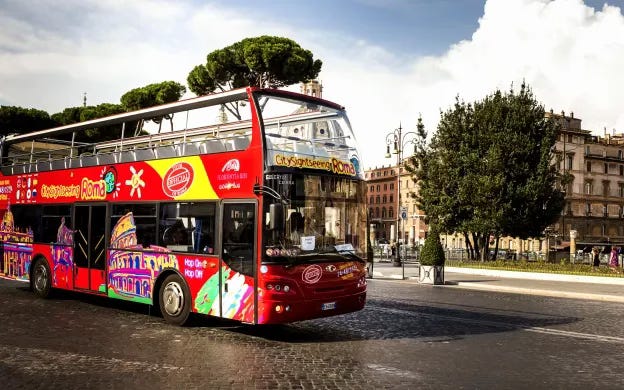


 I’ve traveled to Berlin, where the bus took me to the Brandenburg Gate, Museum Island, and Checkpoint Charlie. In Paris, I saw Notre Dame, cruised the Left Bank, and passed the Louvre and the Eiffel Tower. While taking a bus in Rome, I circled the Colosseum, found where I could see St. Peter in Chains, and stopped at St. Peter’s Cathedral. In London, these tour buses took me to the Tower of London, St. Paul’s, and Trafalgar Square.