 Peace negotiators in Switzerland may be dotting the i’s on a deal to end the Iran war, but air travelers are still paying extra checked bag fees.
Remember when jet fuel prices spiked after the U.S. and Israel launched attacks on Iran earlier this year? Every major American airline rushed to raise its checked bag fees. United, American, Delta, Southwest, JetBlue — they all went up. Southwest, which had only just killed its beloved “Bags Fly Free” policy last year under investor pressure, raised its first-bag fee to $45. United pushed its airport counter fee to $50.
The airlines blamed the war, and they had a point. Jet fuel jumped from about $99 a barrel in late February to as high as $209 a barrel by early April.
But then the first ceasefire came, and a peace deal appeared to be within reach. Oil prices have pulled back from their highs. Source: U.S. Energy Information Administration, and Europe Brent spot price (daily closes through June 15, 2026). The dashed June 19 point reflects market quotes and is not yet an official EIA close. Jet fuel tracks crude with a lag. EIA’s latest Gulf Coast jet fuel reading was about $3.02 a gallon on June 15.
The airlines blamed the war, and they had a point.
Jet fuel jumped from about $99 a barrel in late February to as high as $209 a barrel by early April.
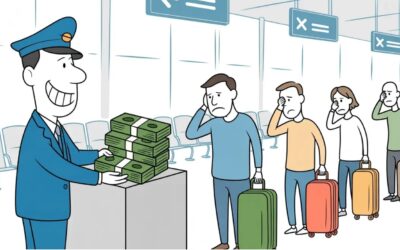
And guess what? Not one airline has announced it’s bringing its luggage fees back down. I’ve called this Elliott’s Luggage Rule: fees rise when oil goes up, and they rise when oil goes down.
How did checked luggage fees get so high?
 Airline luggage fees were already ridiculously high before the war. Checking a suitcase had hit $50 at major carriers, and baggage fees brought in an extra $7 billion in revenue in 2024. The fees had long been untethered from any actual relationship to what it costs to move your bag.
Then the war gave airlines cover to raise fees again, and they took it.
Airlines raised fares, hiked baggage fees, added fuel surcharges and cut flight schedules. That may have made sense this spring, but makes considerably less sense now that the worst of the crisis appears to be over.
The airlines will tell you costs are still elevated and that fuel prices haven’t fully normalized. Technically, that’s true. Although oil prices retreated after the ceasefire announcements, they haven’t returned to their pre-war levels yet. But they are coming down quickly.
A coincidence worth noting
The war-fueled fee increases arrived just as the baggage landscape was about to get a lot more interesting.
EU ambassadors reached a final agreement earlier this week requiring airlines to include the cost of a standard carry-on bag in their base fare, with passengers able to opt out for a discount instead of paying a penalty to bring one.
In other words, you get a fare quote with the bag included. You uncheck a box to pay less if you don’t want it.
That’s how it always should have worked
Airlines claim they need the revenue. But consider what’s happening at the gate this summer, where agents have quietly been tightening enforcement of carry-on size limits and shifting toward a strict 22 x 14 x 9-inch standard.
That means the spinner you’ve flown with a hundred times might not make it past the gate sizer in July. Airlines are now measuring bags at the gate with automated scanners, and gate-check fees range from $60 to $100.
So even if airlines lower their checked baggage fees, they can make up for it by charging you extra for your carry-on.
What the airlines should do
When the war starts winding down, airlines should roll back the fee increases they attributed to the conflict.
I know, you can stop laughing now.

Christopher Elliott is the founder of Elliott Advocacy, a 501(c)(3) nonprofit organization that empowers consumers to solve their problems and helps those who can’t. He’s the author of numerous books on consumer advocacy and writes three nationally syndicated columns. He also publishes the Elliott Report, a news site for consumers, and Elliott Confidential, a critically acclaimed newsletter about customer service. If you have a consumer problem you can’t solve, contact him directly through his advocacy website. You can also follow him on X, Facebook, and LinkedIn, or sign up for his daily newsletter.