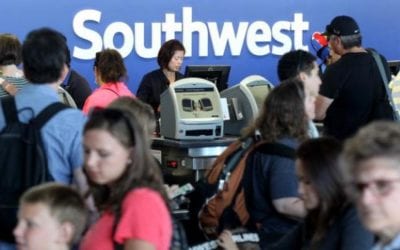
Cruisers miss their last-minute cruise departures from the port of embarkation due to flight delays. Cruisers must schedule to arrive 1-3 days early.
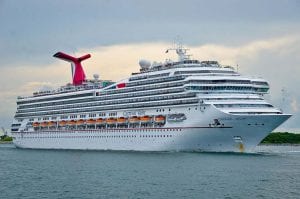 Last-minute cruise departures from the port of embarkation can cost you. Last week, several friends were scheduled to depart on Caribbean cruises from Florida on January 25. All of them missed their ships’ departures because of a massive snowstorm that blanketed much of the East Coast. Each met their ships on January 27 at a port of call. They either couldn’t get a flight to the second day port or their ship was at sea on the second day of the sailing.
They made their own domestic flight reservations. Their cruise line will offer no refund. Fortunately, each had trip insurance. That won’t make up for losing as much as 37.5 percent of their cruise vacations.
They could have avoided the missed sailings if they followed my long time cruise embarkation advice.
Cruisers should always arrive at their domestic port of embarkation at least one day in advance and their international port of embarkation at least three days in advance of their sailing.
I also recommend that cruisers track the weather at home and at the port of embarkation in case they need to adjust their flights. In fact, my friends’ airlines offered free rebooking to alternative flights the day before their scheduled Sunday flights, but they didn’t want to pay for a hotel stay.
While winter weather can foul air travel plans, so can tornadoes and hurricanes. Last-minute cruise departures don’t work.
More than winter weather can foul air travel plans. In the U.S., both the long tornado and hurricane seasons can wreak havoc on airline schedules. No matter where it occurs, severe weather in the U.S., for example, can affect flights in distant cities. Flights taking passengers to their cruise ships from their home airports can be severely delayed by planes held up by weather from getting to the cruisers’ home airports. Each first delay can create a domino effect delaying multiple subsequent flights.
Some years ago, bad weather delayed my flight to Barcelona for a cruise. I eventually arrived with time to spare, but my luggage was still in the U.S.
Some years ago, my wife and I were scheduled to take a three-week Mediterranean cruise departing from the great city of Barcelona. Fortunately, we planned to arrive in Barcelona three nights before our departure. The plane bound for our airport, then on to Atlanta for Barcelona, was seriously delayed by tornadoes. We had allowed four hours in Atlanta for our layover before the Barcelona flight. It wasn’t enough. Our flight arrived in Atlanta 15 minutes after our flight to Spain departed.
Our cruise line had made the plane reservations for us, along with eight others on our flight. While we were in the air to Atlanta, they rebooked us on an Air France flight to Paris and after a layover, another Air France flight to Barcelona. About 15 minutes after we deplaned in Atlanta, we were in the air to Paris. We knew our luggage was still in Atlanta.
As expected, when we arrived in Barcelona, the luggage for the 10 of us wasn’t there. We put in our baggage claim and explained what happened. They said they’d get us our bags by late the next day. At least we had our carry-on luggage.
There was no luggage the next afternoon. We called the cruise line, since they made the flight arrangements. They called Air France who said they couldn’t find any of our bags in Paris. No kidding! The cruise line explained the situation. Air France said they’d take care of it.
The next day, again, no luggage.
The cruise line’s help desk at the hotel was open. Their representative called Air France and got the same run around. We asked her to call Delta. Delta said Air France has to look again in Paris. Our cruise line representative escalated while we stood at her desk listening into the conversation. The cruise line representative literally begged Delta to contact their lost baggage personnel at Atlanta. They grudgingly agreed and conferenced us into the call.
We all held our breath.
The Delta agent in Atlanta asked us to hold on so she could look. Less than 30 seconds later she said, “I have all 10 bags right here. We were waiting to be told what to do with them. We’ll get them on the plane to Barcelona tonight and they’ll be delivered to the hotel by noon tomorrow, Barcelona time.”
We got our luggage after lunch with all of our belongings in time for our three weeks at sea, but only because we arrived at our port of embarkation three nights before our scheduled departure.
More than 250 other passengers on our cruise weren’t so lucky. They all had difficulties because of the U.S. tornadoes, but many arrived the day of embarkation, while others who had made their own flight arrangements hadn’t reached the right person at their airline in time to get their bags. Many U.S. passengers on our cruise weren’t reunited with their luggage until we arrived in Athens, 12 nights into the cruise, with less than half the cruise left.
We were thankful that we followed our own advice and scheduled our arrival at our international port of embarkation at least three days before departure. Many others paid the price of cutting their schedule too close.
NCL will no longer make flight arrangements for passengers to arrive on the day of embarkation.
Norwegian Cruise Line (NCL) was in the news last week for its new policy on air bookings for its passengers. Apparently, they’ve been reading my column here at Travelers United (LOL).
Just last week, they announced their new air policy for guests booking air travel then, stating,
“Beginning today, January 26, all guests booking air travel through all NCL Air programs will be required to arrive at their embarkation port at least one day prior to sailing. This enhancement applies to all new air-inclusive reservations that are repriced on or after January 26, 2026.”
NCL followed up, speaking about their guests missing cruise embarkations due to flight delays and having to embark on their cruises at a later port of call, sometimes missing a significant portion of their cruise. I believe the change is definitely in the best interests of cruise passengers and it will halt complaints by passengers that NCL caused them to miss the ships’ sailings.
On the other hand, I’m sure some cruisers will be upset by the new policy: if they have NCL make their flight reservations, they’ll have to pay for at least one night at the port of embarkation. Of course, those passengers can opt to make their own last-minute flight arrangement to come in the day of the sailing and take a real chance that they might not arrive on time.
All cruise lines should require passengers arrive at the port of embarkation at least one day in advance domestically and three days in advance internationally.
NCL made a smart move by requiring passengers to arrive at the port of embarkation at least a day in advance if they had requested flight arrangements. The other cruise lines should adopt the same policy. Better yet, all cruise lines should adopt my recommendation for the flight arrangements they make for their passengers. Guests departing from a domestic cruise port should be required to fly in at least one day in advance, and guests departing from an international cruise port should be required to fly in at least three days in advance.
READ ALSO:
Careless travelers: Why are passengers becoming so absent-minded?
Traveling as an Ugly American in 2026

After many years working in corporate America as a chemical engineer, executive and eventually CFO of a multinational manufacturer, Ned founded a tech consulting company and later restarted NSL Photography, his photography business. Before entering the corporate world, Ned worked as a Public Health Engineer for the Philadelphia Department of Public Health. As a well known corporate, travel and wildlife photographer, Ned travels the world writing about travel and photography, as well as running photography workshops, seminars and photowalks. Visit Ned’s Photography Blog and Galleries.