Transportation Secretary Duffy wants everyone to dress for respect to restore civility in air travel.
 I remember the days of the “Golden Age” of air travel. I remember it both fondly and . . . not so fondly. My first flight was in 1954 and everyone was dressed to the “nines.” This meant suits and sports jackets for men, as well as dresses and stoles for women, plus high heels. Children dressed similarly when possible. Not eight at the time, I wore a sports jacket, tie, “good” pants, and dress shoes. But this trend won’t become standard; bringing civility to air travel will take a multi-pronged effort.
That won’t come until airlines show air travelers respect by offering better products and reasonable compensation when problems arise under airline control. It would also help if government officials showed civility and respect for all Americans, starting at the top.
Air travelers in the ’50s were almost always well dressed, but that they were also almost always civil is a fantasy.
Everyone in those days was beautifully dressed while flying. It was the ’50s! The thing is, it didn’t stop bad behavior. A youngster sat behind my mom on that flight and kept kicking her seat. The purser eventually got the child’s father to control his son. A man a couple of rows up from us was drunk. He was loud and obnoxious. He shouldn’t have been allowed to fly. Eventually, he went to sleep, but for quite awhile everyone on the plane suffered from his drunken behavior.
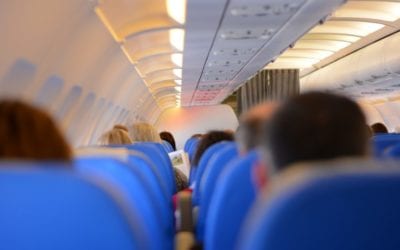
In making his plea for air travelers to be respectful when aloft, Transportation Secretary Sean Duffy showed a video imploring us to fly with good manners while “dressing with respect.” The video shows flight images from the 1950s and 1960s with everyone dressed the way we were in 1954. Then it shows fliers today, in bare feet and leggings, plus T-shirts and ball caps. Duffy inferred that if you’re not dressed as if you just came out of a 1950’s period piece, you’ll be obnoxious and out of control.
The Department of Transportation’s statistics on airplane behavior are misleading. While poor behavior on planes needs to improve, the severity of the problem is not like Secretary Duffy infers.
In their November press release, the U.S. Department of Transportation released a set of misleading statistics. They said that since 2019 there has been a 400 percent increase of in-flight outbursts, “…ranging from disruptive behavior to outright violence.” They said that there were 13,800 unruly passengers since 2021. According to the Bureau of Transportation Statistics and Statista, over 2.3 billion passengers have flown in the U.S. since 2021. So, those unruly passengers make up no more than 0.0006 percent of all air travelers since 2021. I believe that air traveler behavior needs improvement, but let’s not get carried away with the overall severity of the problem.
Moreover, let’s not jump to the conclusion that dressing like the characters in “Happy Days,” the Fonz excluded, will make any difference in behavior aboard planes in the 21st century. Other things can make a difference.
Air travel in the “Golden Age” was easier, with more comfortable cabins and few, if any, luggage woes.
 On my 1954 flight from Philadelphia to San Juan, we flew in economy. It had generous legroom, comfortable seats, good food and snacks and a great lounge area in the rear open to all.
Lost luggage in the “Golden Age” wasn’t a problem. The baggage systems were passenger to plane and back again with no intervening conveyor belts and inspection stations. That resulted in small carry-on bags, just large enough for what you needed for the flight; a few breakables and valuables, snacks, a book and cards. You didn’t have to bring all your essentials into the plane cabin. You could leave them in your checked bag, so boarding was fast and overhead bins, though small, were mostly empty. No one ever heard of the term “gate check.”
At the gates, lines were short, as planes were small. Even the “huge” Constellation that flew daily to Europe only had 81 seats. On my last flight to Europe, the Boeing 787–9 had 285 seats and every passenger had a roller carry-on and a large personal item.
During the “Golden Age,” dressing up was standard, but that didn’t stop bad behavior in those days either.
Screaming matches occurred on many of my flights during the “Golden Age.” Dressing with respect was standard then, but those of us who flew then can tell you that there was still plenty of bad behavior. Smoker versus non-smoker often resulted in major confrontations when smokers would seemingly deliberately blow smoke onto non-smokers who dared go to the lavatory, which was always in the smoking section. Kids, all dressed up, still screamed at times and kicked seats, too. Adults were often selfish despite how they were dressed. If you traveled during the December holidays the number of bags ballooned and arguments often occurred as people got hit in the head by them during boarding.
It’s more important to dress for comfort, safety, and respect.
Forget “dressing for respect.” Wear clothes for comfort and safety. I couldn’t care less about looking snazzy and spiffy. I recommend wearing comfortable clothing made with natural fibers to the extent possible. They breathe and unlike synthetics or high synthetic content blends, won’t melt on your skin in a fire, causing serious burns. I recommend wearing simple clothing that’s not particularly loose, so it won’t snag on obstacles during an evacuation. Wear long pants and a long sleeve shirt to protect you on an emergency slide, unlike dresses and shorts. Wear leather shoes or sneakers for protection to walk safely over debris after a crash. Sandals and flip-flops won’t be safe. Leather shoes or sneakers are also safe going down an emergency slide without catching on the slide or sides, unlike high heels.
In other words, forget Sean Duffy’s “dress for respect.” Instead, while you should always wear clothing that’s neat and clean, dress for comfort and particularly for safety.
If airlines would improve their product, passenger-airline tensions would get better, helping to improve civility.
A way to improve civility and good manners on flights would be to improve the product substantially. That would go a long way to reduce passenger-airline tensions and show respect for air travelers.
The airlines need to stop designing economy seating where the bulk of passengers sit as in a cattle car by bringing back decently-sized seats with reasonable legroom. On many planes flying in the U.S., seat pitch, the distance between rows, is a joke in the economy section unless you’re under 5 feet, 2 inches. And seat width? Oh my! On United, seats on some planes are as narrow as 16.3 inches.
If the U.S. would require adequate compensation for problems under airline control it would reduce tensions and improve civility, too.
The U.S. needs to require adequate compensation for flight delays, lost or missing luggage, flight cancellations, long waits on the tarmac and being involuntarily bumped for any reason. Recently, the U.S. substantially increased air traveler consternation by backing out of reasonable compensation rules for significant delays or cancellations within airline control.
Government officials should treat all Americans with the respect they deserve. That may lead to increased civility across the nation.
Finally, a great way to improve airport and inflight civility and respect would be for the federal government to set a positive example for the flying public. Civility and respect for the individual should start at the top. How about if the U.S. President would refrain from future name calling and treat every traveler with the respect they should command as human beings. How about if the U.S. President stops making so many outrageous insults like when he calls people “dummy,” “low IQ,” or ”piggy,” just because they disagree with him. Others may follow that example, like they do now.
Dressing up isn’t going to bring civility and respect to the air transportation system. Improved air transportation products and reasonable compensation to passengers, showing them the respect they deserve, could go a long way to bring a better atmosphere in airports and aloft, as would those calling for civility and respect to actually show it themselves.
(Image: American Airlines A319 landing at Philadelphia International Airport. Copyright © 2018 NSL Photography. All Rights Reserved. All TDM and AI Training are prohibited.)

READ ALSO:
Planning a trip for 2026? Don’t miss travel insurance
Why is the hotel lobby working with government to restrict short-term rentals?

After many years working in corporate America as a chemical engineer, executive and eventually CFO of a multinational manufacturer, Ned founded a tech consulting company and later restarted NSL Photography, his photography business. Before entering the corporate world, Ned worked as a Public Health Engineer for the Philadelphia Department of Public Health. As a well known corporate, travel and wildlife photographer, Ned travels the world writing about travel and photography, as well as running photography workshops, seminars and photowalks. Visit Ned’s Photography Blog and Galleries.