United vs. American Airlines: reducing competition, and the FAA is stepping in. This is one of many problems facing travelers that Congress should address.
Brace yourself if you’re flying through O’Hare Airport this summer. United vs. American Airlines at O’Hare Airport are having a fight and United wants to crowd out American Airlines.
Depending on the Federal Aviation Administration’s decisions over the coming weeks, fewer choices, higher fares and more disruption are likely headed your way — and not entirely by accident.
The agency has been forced to step in ahead of the busy summer season to address the gap between scheduled flights and the capacity the airport is actually equipped to handle. For the millions of passengers who rely on O’Hare every year, the FAA’s decision will not be an abstraction. It could mean a missed connection, a canceled trip or a fare that suddenly costs twice what it did last year.
This crisis didn’t happen on its own.
It was triggered, and arguably even engineered, by United Airlines’ deliberate strategy to gain more control of the airport. Airlines have over-scheduled O’Hare for this upcoming summer, projecting more than 3,000 daily operations, up from around 2,680 during peak days last year. The FAA determined that the airport’s infrastructure and air traffic control staffing cannot safely support that volume — and Chicago is all too familiar with why that can’t stand. During the 2025 government shutdown, controller shortages triggered ground stops and dozens of daily cancellations at O’Hare alone.
Knowing this, why are airlines scheduling so far beyond what the airport can handle?
United Airlines is clear — chaos is fine, as long as the fix hurts competitors more.
 United is planning 750 daily departures from O’Hare this summer, an increase of more than 30%, according to Crain’s Chicago Business. These aren’t in-demand routes launched to help travelers. They are designed to exploit O’Hare’s gate assignment policy, which allocates gates based solely on flights scheduled — a “use it or lose it” approach.
On a January earnings call, United CEO Scott Kirby declared: “We’re not going to allow them [American Airlines] to win a single gate at our expense in 2026.” His chief financial officer called American’s presence at O’Hare temporary, predicting that “everybody is switching from American to United.”
Turf war
This is not a passenger service strategy. This is a land grab. United Airlines is adding dozens of low-demand flights, knowing that it can roll them back once the FAA mandates cuts and still come out ahead of other carriers forced to cancel their own valuable flights. The airline has also been buying up gates, including paying $30 million for Spirit Airlines’ gates that it previously claimed were not of interest. With its scheduling surge, United is burning through O’Hare’s finite capacity not to better serve travelers but to crowd out rivals.
Why does this matter beyond a corporate turf war? Because O’Hare is one of the last major U.S. airports where two legacy carriers genuinely compete through dual hubs, and that competition directly benefits passengers. Fares stay lower. Service improves. Travelers have real choices.
American Airlines may not admit it, but with its comparatively smaller hub, it has invested in upgrading its Chicago product precisely because competition demands it.
The warning signs of a less competitive O’Hare are already visible.
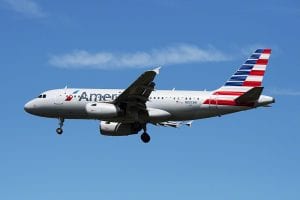
American Airlines A319 landing at Philadelphia International Airport. Copyright © 2018 NSL Photography. All Rights Reserved. All TDM and AI Training are Prohibited.
Southwest is already planning to exit the airport. As United crowds out rivals, options disappear and travelers lose leverage. A United near-monopoly wouldn’t just be bad for Chicago, it would be bad for the millions of connecting passengers who pass through O’Hare every year.
The FAA and Congress are not off the hook.
Flight caps are a band-aid, not a cure, and a resilient solution — at O’Hare, and beyond — means more work ahead. Our air traffic control system still runs on decades-old technology despite significant public investment over the past decade. Thousands of controller positions remain unfilled.
Senators Tammy Duckworth and Dick Durbin of Illinois have rightly urged the FAA to fix O’Hare’s staffing crisis beyond addressing flight schedules. So far, the urgency hasn’t matched the rhetoric. U.S. travelers pay more than 20% of their ticket price in taxes and fees. They are entitled to a modern, functioning system in return.
Testing travelers’ patience
The FAA and Department of Transportation must examine whether United’s scheduling practices constitute anti-competitive manipulation of gate allocation rules. Congress must treat air traffic control modernization as the national infrastructure emergency it is. Chicago and federal regulators must recognize that protecting O’Hare’s dual-hub status is a form of consumer protection and ensure that plans for flight cuts don’t ultimately reward anti-competitive behavior. And any flight reductions this summer must come with enforceable passenger protections: transparent rebooking, no fare-gouging, and clear communication to affected travelers.

O’Hare’s crisis is a microcosm of everything wrong in U.S. aviation.
The system suffers from underinvestment in infrastructure, airlines that prioritize dominance over service, and regulators perpetually playing catch-up. Travelers have been patient through shutdowns, staffing crises, and a capacity crunch that was foreseeable and deliberately manufactured.
The FAA has the authority to act. Congress has the tools. What has been missing for too long is the will to put travelers first. That’s what every passenger flying through O’Hare this summer deserves.
READ ALSO:
How to get through TSA airport checkpoints safely during the shutdown now
The Iran war affects ticket prices in strange ways
Follow-up (dated April 16, 2026)
Today’s FAA decision on scheduling at O’Hare International Airport [LINK] means smoother travel for Chicago travelers and anyone flying through ORD. It correctly keeps flight volumes within the airport’s capacity. It also ensures no one airline can push out competitors. This finding ensures the benefits of Chicago’s dual hub. You can read more in our op-ed last month calling for the FAA to take action on behalf of travelers.

Charlie Leocha is the President of Travelers United. He has been working in Washington, DC, for the past 14 years with Congress, the Department of Transportation, and industry stakeholders on travel issues. He was the first consumer representative to the Advisory Committee for Aviation Consumer Protections appointed by the Secretary of Transportation from 2012 through 2018.