
I discuss three of the worst cruise scams and how to recognize them to avoid becoming a victim of them.
 Here are three of the worst cruise scams. Unfortunately, like many travel genres, cruise vacations have their share of scams that can ruin the journey, end it before it starts, or make the cost far more than anyone could imagine.
While there are many travelers who choose to not cruise, there are many who enjoy cruising and see the benefit of it for particular destinations that are more easily or better seen via cruising.
Cruise scams take many forms. The three worst cruise scams listed below are ones I’ve personally seen. I hope that by describing them and offering potential ways to identify them, you won’t fall prey to them.
The “You’ve won a free cruise” scam is one of the worst cruise scams and catches those who are not alert to them.
“You’ve won a free cruise” scam:
One of the most common cruise scams arrives via email, text message, postal mail or more often than not, unsolicited phone calls. Free cruise scams typically come with fake heavy fees and taxes, payable instantly to book the free cruise. Sometimes the free cruises don’t even exist.
Often, if the free cruise actually exists, the scammer doesn’t book it, despite the scam victim’s payment of hundreds, perhaps thousands of dollars for fake fees and taxes.
Last week, I received a free cruise scam call, but recognized it immediately.
At least three or four times a year, I get free cruise offers via text message. Just last week, I picked up the phone to hear a free cruise offer from a smooth-talking man. It was for a five-night cruise from the ports of New York to Bermuda on Royal Caribbean. The cruise was to leave on September 14. To book the free cruise, I only had to pay $550 in port taxes and booking fees per person. I played along for a short time to hear more details. The man told me that it was for an inside cabin for two, but if I wanted a balcony cabin it would only cost $1,000 for the upgrade. I thanked him and said I’d have to speak to my wife before booking. He hung up. He knew that I wasn’t buying it.
To see how illegitimate the offer was, I went to Royal Caribbean’s website.
Unsurprisingly, I found that there was no cruise to Bermuda that day. I had avoided a scam. If I took the offer, I would’ve lost every cent paid. By the way, the amount they told me to pay was more than Royal Caribbean charges for a balcony cabin on one of their actual five-day Bermuda cruises in September.
How did I know it was a scam? There were red flags throughout the short phone call. The call was unsolicited. It required payment in full the day of the call for the fees, taxes and upgrade. Before I even said anything about booking, the scammer was already asking for my Social Security number and credit card information so they could get the booking started. In less than a minute after I picked up the phone, they were already using pressure tactics to get me to sign up, saying that I would, “Miss the offer if I didn’t take it within the next 10 minutes.” Don’t succumb to pressure tactics like that.
Among social media scams, phishing scams are well-known efforts to try to snare cruisers.
Phishing scams on social media sites:
There are many phishing scams on social media, such as Facebook. Ads on Facebook with gorgeous photos of beautiful cruise ships accompanying offers of heavily discounted cruises and free cruise drawings seem to be there daily.
To enter, all you need to do is fill out a short survey or an entry form. Unfortunately, the survey and entry form have required fields to make you reveal private identity information and even credit card information because you’ll need to pay directly for the taxes and fees not included in the discounted or free cruise.
Scammers use the detailed information you freely provide in the survey or entry form for identity theft and/or to fraudulently charge purchases to your credit card account or empty your bank accounts connected to your debit card.
Frankly, the old adage that says “If it’s too good to be true, it probably is,” should be believed when you see advertisements on social media for heavily discounted of free cruises. My best advice is never participate in surveys or fill out entry forms solicited on social media. If you think the offer is legitimate, check it out with the cruise line first.
I’ve heard from readers who lost money to fake port excursions over the years.
Fake cruise port excursion scams:
There are many legitimate third party cruise excursion companies based at cruise ports of call. The problem is that too many cruise excursion companies listed on the Internet are fake.
If you book a cruise port excursion via a third-party company, not the cruise line, you could lose the entire excursion fee even if they’re legitimate. If they’re illegitimate, having given them considerable personal information including your name, address, email, and likely phone number, as well as your credit card information, identity theft and/or financial fraud may be the result. According to the terms of the excursion purchase, even from a legitimate cruise excursion company, if a port of call is skipped for whatever reason, such as bad weather, difficult seas or other factors, and you miss the excursion, it’s possible that you won’t be able to obtain a refund.
My wife and I make it a firm practice that if we purchase excursions from a third-party company that they will only be from a major, reputable, well-known excursion booking agency. Moreover, we never pay for third-party company excursions by debit card or an electronic payment system like Zelle. We use credit cards because of their user protection. Debit cards and cash payment systems don’t have much, if any, protection for users. While there is no guarantee that you’ll get your money back from the credit card company, you have virtually no help if you’ve paid via a debit card or cash payment system.
We purchase cruise port excursions solely from cruise lines to both avoid scams and prevent missing the cruise ship sailing if our excursion has problems and returns to the ship late.
We have purchased pre- and post-cruise excursions via third party companies, but only ones that are well-known and highly rated. For excursions at ports of call during our cruises, we book excursions exclusively through the cruise line. We do that to be sure the excursions are legitimate, but more than that, to be sure that if we return to the ship late due to some problem, it won’t have sailed without us. If you book an excursion via a third party company and don’t arrive back at the ship on time, it’s likely that you’ll find that the cruise ship has sailed. Over the years, I’ve seen that happen numerous times.
These are three of the worst and most prevalent cruise scams of which I’m aware. If you’re interested in cruising, be careful — don’t fall for one of these scams.
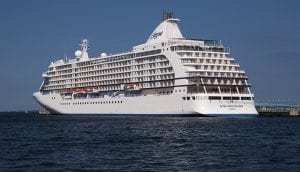
(Image: Regent Seven Seas Voyager at Tallin, Estonia. Copyright © 2018 NSL Photography.)
READ ALSO:
Dress better and improve flying behavior. Will it work?
Surviving the cold and lack of oxygen from aircraft rapid decompression

After many years working in corporate America as a chemical engineer, executive and eventually CFO of a multinational manufacturer, Ned founded a tech consulting company and later restarted NSL Photography, his photography business. Before entering the corporate world, Ned worked as a Public Health Engineer for the Philadelphia Department of Public Health. As a well known corporate, travel and wildlife photographer, Ned travels the world writing about travel and photography, as well as running photography workshops, seminars and photowalks. Visit Ned’s Photography Blog and Galleries.