
Commonsense precautions and actions can help airplane passengers survive the cold and lack of oxygen from aircraft decompression.
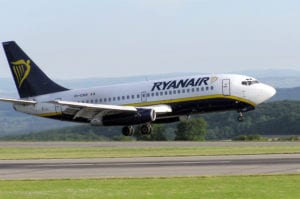 Ryanair flight FR1878 was scheduled to fly from Thessaloniki, Greece, to Memmingen, Germany, on Friday, July 10, 2026. It left 17 minutes late at 6:12 a.m. The Boeing 737–800 was operated by Malta Air. According to Flightradar24 the flight changed dramatically after takeoff at about 16,000 feet, when it turned around to head back to Thessaloniki’s airport.
It’s been reported that one of the jet’s two CFM International CFM56–7B engines had a major failure and debris from the engine hit the plane’s cabin, damaging the aircraft’s structure and breaking one of the cabin’s windows.
A broken window caused by debris from a failed engine hitting it caused the Ryanair jet to have rapid decompression and push a passenger partially through a window.
The broken window resulted in the plane’s rapid decompression. Immediately, the oxygen masks were released and dropped. The passenger seated beside the broken window suffered serious but not life threatening injuries from his head and shoulders being pulled through the window frame by the decompression forces. The plane successfully landed back at Thessaloniki and the injured passenger was rushed to a local hospital after being pulled back into the plane from the freezing wind outside of the aircraft. It was about 1°F outside the plane as he went through the window.
The passenger’s wife and other passengers grabbed his legs and eventually pulled him back inside the plane.
It’s unlikely you’ll ever be involved in a rapid decompression incident, as statistics show that there are only about 40–50 rapid decompression accidents world-wide each year, but you should be prepared to deal with such incidents and other possible airplane accidents.
The time before you lose consciousness and the temperature of the air coming into the plane depend on the plane’s altitude when rapid decompression occurs.
If rapid decompression occurs on your flight, you may not have much time to act before you lose consciousness from hypoxia. Ryanair flight FR1878 was only at about 16,000 feet when the engine failed. At that altitude the Time of Useful Consciousness (TUC) before you pass out is about a half hour. Had they been at 25,000 feet, the TUC would have been just three to five minutes.
Passengers on Qantas flight 30 who were flying from Hong Kong to Melbourne, Australia, in July 2008, know too well how quickly hypoxia can result in unconsciousness. At 29,000 feet, the Boeing 747–400 suffered explosive decompression. The TUC at 30,000 feet is 1–2 minutes and the temperature outside the plane at that altitude was from -31°F to -67°F.
When rapid decompression occurs, pilots and flight attendants must first protect themselves before they can assist passengers. Passengers shouldn’t wait for help, but start helping themselves immediately after the decompression starts.
When rapid or explosive decompression occurs, pilots are required to immediately place their oxygen masks on. They put their mask setting to 100 percent oxygen to ensure they stay conscious and alert. Then they initiate an emergency descent to an altitude of 10,000 feet or the lowest safe altitude that’s possible. At that altitude there is enough breathable air for humans without aircraft pressurization. Then the pilots turn on the seat belt sign to remind passengers who might not have kept their seat belt on during the flight to get them on immediately.
At the same time, the cabin crew is putting on their oxygen masks too. Before they can start to help passengers, they must first protect themselves by putting on their portable oxygen mask systems.
While the flight crew is getting their oxygen so they can safely move about the cabin, passengers should immediately act for themselves. They should not wait for the flight attendants to assist. They might be helping other passengers for a while or may be having difficulty moving around the cabin due to debris, or awaiting instructions from the cockpit.
Passengers should put on their oxygen masks when decompression occurs before helping anyone else, including their own children.
When rapid decompression occurs, the oxygen masks should drop from overhead. Put them over your mouth, slip the straps over your head, then tighten them by pulling their ends. Breathe into the mask normally. The mask’s bag might not inflate, or inflate only while you’re exhaling. If it doesn’t inflate, it doesn’t mean it’s not working.
On the Ryanair flight, there is no report of oxygen masks not dropping at all the seats. On Qantas flight 30, some oxygen masks didn’t deploy. If this happens it’s generally easy to pry open the mask access panel to free the masks. Otherwise, look for empty seats to use their masks. It’s also possible to share masks, if necessary. Remember, you’ll only need to use the oxygen masks until the plane completes its emergency descent to breathable oxygen.
if you’re traveling with children or the elderly, put on your mask first, then help with theirs. There’s a reasonable amount of time to get everyone’s mask on once you don your mask first.
There’s no emergency oxygen in the plane’s lavatory. If you’re in there, in case of decompression, get to your seat immediately.
If rapid decompression occurs while you’re in the lavatory, you will have to try to get to your seat for oxygen quickly, as there’s no emergency oxygen in the lavatory due to potential security threats.
If you know someone’s in the lavatory, don’t remove your mask to attempt to help them directly unless you’re a healthy adult and the plane’s been descending for at least 1–2 minutes. You can’t help them if you pass out. Instead, immediately attempt to get a flight attendant’s attention. They have portable emergency oxygen and can render assistance.
When traveling with children, always accompany them to the lavatory and stay next to it while they are inside. That way you will be in position to help them, if necessary.
Shortly after the aircraft suffers rapid decompression you’ll likely feel the plane dropping fast. That’s generally a good sign that the pilots are in control and quickly descending the aircraft to a “breathable” altitude.
Passengers should remain calm. Everyone will likely survive the rapid decompression.
Try to remain calm. Passengers of commercial aircraft which go through rapid decompression normally survive with no adverse long term health effects. Everyone on the Ryanair flight walked away okay except for the passenger who went through the window. Even with a huge hole, approximately six feet wide by five feet high in the side of the plane, everyone on Qantas flight 30 landed alive and safe.
There are two commonsense actions you can use to survive the cold and hypoxia of rapid decompression.
Wear sensible clothing. I wear long pants and long sleeved shirts, made with natural fibers (synthetics or high synthetic content blends can be a fire hazard in a crash) when flying. It can help you stay warm in case of rapid decompression. I have a jacket with me when flying to help me stay warm in case of airplane air conditioning problems or in case of an accident. Loose or elaborate clothing can get snagged on obstacles in a plane’s tight quarters, especially if there’s some damage. For women, don’t wear high heels or sandals in case of debris in the cabin.
The most important action that every passenger must take on every flight is to wear your seat belt at all times while in-flight when in your seat. That will protect you during severe turbulence as well as if rapid decompression occurs.
Use commonsense prevention, stay calm, wear your seat belt and follow the procedure described by your flight attendant in the preflight briefing if rapid decompression occurs.

After many years working in corporate America as a chemical engineer, executive and eventually CFO of a multinational manufacturer, Ned founded a tech consulting company and later restarted NSL Photography, his photography business. Before entering the corporate world, Ned worked as a Public Health Engineer for the Philadelphia Department of Public Health. As a well known corporate, travel and wildlife photographer, Ned travels the world writing about travel and photography, as well as running photography workshops, seminars and photowalks. Visit Ned’s Photography Blog and Galleries.