

We’re barely into back-to-school season and already the worrisome stories are circulating. A USA Today story recently estimated as many as half the U.S. may end up infected with H1N1 aka “swine” flu.
Now, many if not most of those cases could be mild, but the fact remains that no one is quite sure how serious this pandemic could be. A vaccine is being formulated and expected to be available within a few months. But it seems relatively likely that we are going to face a fall with a lot of contagious people.
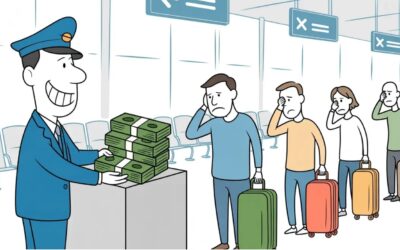
Perhaps this might be the time for the airlines to step up proactively, and do their part to help keeping the flu from spreading. Which means waiving the $150 change fee for documented cases of H1N1.
As most long-time travelers remember, a doctor’s note used to get you out of any airline change fee. Of course, the fees were a lot smaller, then, in the $50 range, and it was before the airlines decided change fees could be a serious revenue source. Also, to be fair, most people I knew would cheerfully get notes from their family doctors and friends, even when they weren’t really sick.
But these days, nothing short of a death certificate will result in a fee waiver for domestic tickets. And the $150 standard fee is PLUS any fare difference. That means a family of four postponing their trip would pay $600 at least; and with a last minute change, probably much more.
Travel insurance of course is always a good idea. The responsible thing to do for travelers without insurance is to pay whatever it takes to change if there is any chance of being contagious.
In the real world, however, leisure travelers on a budget are likely to be tempted to fly anyway if they are “almost over” the flu, or if they aren’t sure what they have. Which could turn airlines into flying petri dishes. And if a few planeloads of people get sick, it could be one more hard blow to an already reeling industry.
Admittedly flu results aren’t available immediately, and no doubt some people may fly when they are asymptomatic, but it seems like any sick travelers kept off a plane would be a step in the right direction.
By requiring documented H1N1 flu for any fee waiver, airlines could avoid all the vague “My patient isn’t feeling well” notes, and it would be an added incentive for clients to get tested instead of hoping they just have a cold.
In addition, if the flu does become widespread, any serious effort by the airlines to show they are trying to keep their planes healthy could also make people feel safer, and thus more likely to fly.
Other options could include masks and hand sanitizers. No doubt if the flu becomes widespread gate agents and or TSA agents will be also warned to be on alert for potentially ill passengers.
Whatever measures the airlines do or don’t decide to take, however, one thing is for sure. It will be a lot better if they come up with a plan in advance, before the first stories make the nightly news.
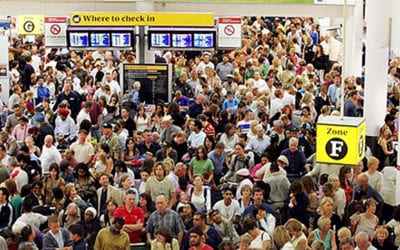
photo by Kyle Simourd/Flickr/Creative Commons

Janice Hough is a California-based travel agent a travel blogger and a part-time comedy writer. A frequent flier herself, she’s been doing battle with airlines, hotels, and other travel companies for over three decades. Besides writing for Travelers United, Janice has a humor blog at Leftcoastsportsbabe.com (Warning, the political and sports humor therein does not represent the views of anyone but herself.)

I definitely agree with the statement that the airlines need to be proactive on this issue.
As for masks and hand sanitizers, it’s my understanding that masks have not been shown to be effective in slowing the spread of H1N1, although they might slow other viruses, which would be a good thing.
Hand sanitizer should be de rigueur, swine flu or no. If cruise ships do it I don’t see why airlines can’t.
Are you sitting down, Janice?
I agree with you, but documentation must be required to prevent abuse of the situation. Many years ago, passengers were required to fly on the day that they were booked, even though, for example, a hurricane was predicted in the area. The airports would be jammed packed with stranded travelers. I’m happy that the industry is more liberal in allowing passengers to “change” travel plans in the face of adverse weather. Swine flu is a sign of the times. Allowing passengers to change their travel plans will certainly help passengers dealing with an serious illness to avoid travel and infecting others.
Puzzled August 27, 2009 at 11:58 am
Hand sanitizer should be de rigueur, swine flu or no. If cruise ships do it I don’t see why airlines can’t.
=====================================================
Interesting that you compare the airline industry to cruise ships. On any given day, ONE LEGACY CARRIER has over 200,000 thousand passengers PER DAY.
In other words, IMAGINE THE COSTS??????????
re: masks. Please remember the masks are for the people who HAVE the cough, fever, or other symptoms, to reduce the spread. They probably would also be used by FAs and health care professionals who work directly with the person considered infected. N95 masks, properly fitted, can be very effective in spreading the disease. A real challenge will be trying to isolate the infected person a few seats and rows away from others when most flights are nearly full these days.
There’s 35 THOUSAND flights in this country daily. Say, only 3 people per flight and the total number of masks per day reaches to over 100,000 PER DAY. It’s costly.
word of caution here…Hand sanitizing does *NOTHING* to swine flu or *ANY* other virus! Infact, by using hand sanitizer, you may be actually helping the swine flu virus thrive and survive on your hand! Our bodies survive by symbiosis! This means that we have bacteria cultures living on our skin. These bacteria cultures are highly territorial and possessive. If an invading organism infiltrates the territory of an active bacteria cluster, that bacteria will attack the invading organism and prevent that organism from propagating! By constantly killing off your symbiotic bacteria, you are leaving your body open for attack (flesh eating bacteria anyone). The world is a very dangerous place, and without our symbiotic relationship with our resident bacteria clusters, we would be dead in a day!
Plus, hand sanitizer uses alcohol to “sanitize”. Alcohol, in the concentrations that hand sanitizers use, does *NOTHING* to viruses. Sure, it kills germs and bacteria, but viruses love the stuff! Let me reiterate. The alcohol in handsanitizers does not kill viruses…(H1N1 is a virus, btw…)
And there’s another Plus (not for us, but the virus) Like other living organisms, whatever kills most organisms, makes the survivors stronger. In other words, it speeds up the mutation of the surviving organism.
So. How to kill viruses…Hmmm, good question. There really are no easy ways to do this…iodine helps, but not much..There’s always bleach…but that can cause more harm than good…About the only thing that reliably kills viruses is Lysol. Liquid or spray. If you use the spray, you have to make sure that the surface you are spraying is thoroughly dampened by the spray! And don’t wipe it off…let it dry naturally, or else you will just be reintroducing viruses into the environment again!
If you MUST use a handsanitizer, make sure that it uses Ethanol instead of isopropyl alcohol…Isopropyl alcohol does NOTHING to viruses…And if you *do* find one that uses Ethanol, make sure that it is at 79% by weight. Only at that concentration will it even tickle the virus. (Lysol Professional uses 79% ethanol)
If you want to be really safe, make your own hand sanitizer. Grain alcohol and water (in a diluted ratio to make 79% alcohol) and some fragrance is all that you need.
Anything less than this leads you to a false sense of security and is worse than nothing at all!
BTW, as for masks…Nothing you can get here in the states will help, but there are these: http://s61.photobucket.com/albums/h48/ekummel/phone/?action=view¤t=IMAGE_079.jpg
Ed
Frank said:
“Interesting that you compare the airline industry to cruise ships. On any given day, ONE LEGACY CARRIER has over 200,000 thousand passengers PER DAY.
In other words, IMAGINE THE COSTS??????????”
Imagine the costs to society of leaving it up to the airlines.