

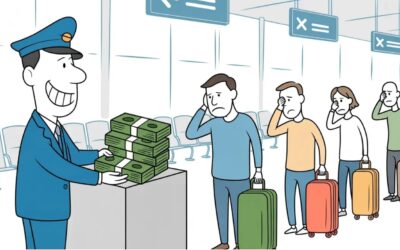
Just when passengers are being nickeled and dimed as if there’s no tomorrow, the parent company of United Airlines announced it earned $273 million in the second quarter of 2010, making it the most profitable quarter in nearly three years. UAL Corp.’s quarterly revenue rose 28.4 percent to $5.16 billion.
The earnings report caused its stock to rise 48 cents, or 2.3 percent, to $21.66 on the following morning. As of July 22nd market close, the stock was listed at $22.78.
This gain shouldn’t be taken personally by passengers. Skip the fact airfares have gone up and it costs $450 each way to upgrade from economy to business class (and not if you opted for the cheapest fare) plus 20,000 miles if you’re flying overseas. And champagne is a thing of the past unless you can persuade a flight attendant to sneak you a glass from the First class section.
Several things improved for the nation’s third-biggest airline, suggesting that it is benefiting from an economic recovery. Per-seat revenue rose 26.9 percent, to 13.02 cents per available seat mile. Cargo revenue increased 57 percent.
A year ago the company earned $28 million because of gains on fuel hedging. This time, UAL’s profit — $1.29 per share — came from flying. But wait a second. Aren’t passengers still paying fuel surcharges, even though its price is no longer at the high, when the fee was imposed?
Not counting special charges, UAL said it would have earned $430 million, or $1.95 per share. Analysts surveyed by Thomson Reuters were expecting a profit of $1.74 per share on revenue of $5.12 billion.
UAL finished the quarter with $5.17 billion in cash. Its headcount shrank 2.7 percent from a year ago, to 42,600 full-time equivalent employees.
Capacity on United mainline jets fell 1.6 percent as it shifted flying to regional airlines flying under the United Express name. Counting those regional airlines, overall flying rose 1.1 percent.
Costs rose 1.9 percent for each mile it flew, not counting fuel and other charges. Don’t get me wrong. Airlines should make a profit. But should it be at the expense of passengers – not to mention the flight crews who’ve taken salary cuts and seen their pensions disappear? In addition, there are fewer attendants in the cabin – all the better not to serve passengers.
United passengers also need to watch their weight for fear they might be asked to deplane as 20 people were recently on a flight from Maine to Washington, DC. Was it because there were too many travelers aboard? Or might it have been that cargo is more profitable than ferrying people? Beats me – but then, I don’t pretend to be an expert about the aviation industry.
Thank goodness for Consumer Traveler to keep me enlightened. People may wonder where all of these profits are going. Perhaps it’s to the lawyers who are hammering out the details of the United and Continental Airlines merger.
How many other people are confused or annoyed when they can’t snag an upgrade? And that goes for 1K members, who have System-wide upgrades in their account but can’t be confirmed in business class until they arrive at the airport.
Karen Fawcett is president of Bonjour Paris

Karen Fawcett loves to travel anywhere. Karen was a founder & president BonjourParis.com while living in Paris for more than 25 years. She has traveled across Europe and the rest of the world. She is now based in Washington, DC.

“I don’t pretend to be an expert about the aviation industry”
I believe you aren’t an expert, but am not convinced about the pretending.
To help you out a bit: United made $273 million dollars in profit on 36 billion (with a “b”) Available Seat Miles. That means that their profit was less than one penny per mile per seat. So, on average, for flying an airplane 500 miles, they make $3.80 in profit for each seat. Remember, that includes baggage fees and all other “nickel and dime” revenue streams. The government makes more off of each passenger than the airlines do.
Despite all the issues (and there are many), it still seems that passengers are getting the good end of the deal.
Excuse me? A company’s main line of business is transporting passengers and you don’t think the profit should come from those passengers? And you think profits are going to legal expenses, which are an expense item?
And what are the red herrings about “fewer attendants” (can you document that assertion?) and slow awarding of upgrades (which actually contributes to profit if you think about it).
I do agree, however, that you are not an expert. But please don’t let that stop you from trying to begrudge a company of profits which they [finally] have rightly earned. And indeed, if they (and the other airlines) don’t earn profits guess what … you get to stay home or drive your next holiday.
There’s nothing wrong with this picture, if you’re a United shareholder or executive. The airline is finally figuring out how to make money.
There’s plenty wrong with it if you’re a United passenger or employee (although the company making money does ultimately benefit the employees by allowing them to keep their jobs!). United is no longer a ‘full-service’ airline, whatever that means in this convoluted world. UA made money by shifting more and more flying to regional airlines; reducing capacity making it harder to find seats; charging fees to their passengers, some understandable, some outrageous, outside of the basic fare.
The ironic part–this may hinder the planned UA/CO merger…UA swears it can’t continue without a merger partner, and it certainly seems that Congress is gunning to break this one up. Congress is still ticked that the DL/NW merger went through, and the resulting DL has not been a customer service coup. If UA makes money in a poor economy, it may signal that they can make a go of it without a partner.
Our UAL flight to Australia in 2007 was the worst International flight we have ever experienced. We booked plenty far in advance but seat assignment was terrible. Food was worse than domestic flight food was when they served food. No more flights on UAL
We’ll know if there is something right or wrong with this picture, and others down the road, if United has learned THE basic customer service maxim: Treat your employees well and they will treat your customers well. It is time for United to stop sucking profits off exclusively to management and shareholders. [I’m a passenger, not affilitated with United except as I pay my fare and a raft of “extras.”]
One of the reasons profitability has risen is probably because the airlines have figured out a way to avoid paying taxes on a lot of revenue — those “extras” don’t count as taxable under the archaic rules currently in place.
Our UA flights this month couldn’t have been more different, though they were both between SFO and LHR in business class. Going east, we had incredibly helpful and cheerful flight attendants (one got my reading light repaired before takeoff), decent food, a priority security lane, and working “amenities”. We were upgraded at the airport and given the seats we requested. Going west, my husband and I had a long queue for security, no working reading lights, no video or audio, middle seats (one with a malfunctioning footrest), miserable food, and unconcerned flight attendants (with one exception). In both cases, the flights were 100% full with a few bumped passengers.
UAL is clearly saving on maintenance and food quality, and it has reduced capacity to the point that it has no seats available to move passengers to if theirs malfunction. It also obviously cares little about alienating its 1K passengers–we asked 6 months ahead of time to use “confirmed” systemwide upgrades, but did not get upgraded until 2 hours before flight time.
what’s wrong with United? The airline has opted out of being in the customer service business. Unless you”re Global Services member, forget any courtesy. I’m 1K and the airline hasn’t merited my loyalty after the change in rules and regs. No upgrades until the very last minute. If I want to travel business class (and need to on long haul flights), it’s better to book with a consolidator.
It’s no pleasure to hear the flight crew grumble about their lower salaries, loss of perks, etc. They are grumpy and I can’t blame them.
Glad profits are up. Morale isn’t.
….
Airlines got out of the “customer service” business years ago. They’re now strictly in the freight business. That’s because we passengers have overwhelmingly expressed our desire to be treated as self-loading cargo by making cheap fares our sole concern when buying plane tickets. The airline executives have listened to the voice of their customers and adjusted their business model accordingly. So they’ve managed to turn a profit, at least when fuel prices don’t make that impossible.
The real problem appears to be that many passengers do not realize that, by their own clearly-expressed preference, airlines now treat them as self-loading cargo. They have unrealistic expectations of “customer service,” abetted by legacy airlines continuing to run deceptive advertising suggesting that they still offer “customer service.” That’s bound to lead to disappointment and anger.
Perhaps when the majority of passengers have adjusted their expectations to match the new reality that airlines are providing the miserable ordeal that they have consistently demanded, it’s possible that flying may paradoxically become less unpleasant. If the airline delivers the self-loading cargo to its destination within a reasonable time of the schedule, with any (fee-paid) ancillary cargo arriving mostly intact within a reasonable time after the flight’s arrival, the airline will have provided complete customer satisfaction. And if the airline provides cost-efficient outsourced or automated mechanisms to offer a minimal level of assistance when complete customer satisfaction does not occur, they will have done what is appropriate to help passengers meet their responsibility for correcting the errors.
I find it interesting that Southwest is honest about not claiming to be anything more than a Greyhound bus with wings. With passenger expectations set appropriately low, they’re usually able to deliver what they promise, thereby satisfying both their customers and their shareholders. It’s probably in the legacy carriers’ best interest to start emulating Southwest, and train their passengers to have low expectations consistent with being self-loading cargo on a freight carrier.
It’s good a few of you see through the whining.
When Karen writes about destinations, it is interesting. But it is the same old whining about not getting upgrades on United, and other 1Ks start to chime in.
People: Upgrades are SPACE AVAILABLE. In your businesses, do you give something away for free (and those systemwide upgrades are GIVEN to them as a thank you for how much they fly) if someone else wants to pay top dollar? OF COURSE NOT! Airlines are trying to sell full-fare tickets…. how shocking! If they don’t fill the cabin that way, those 1Ks and other frequent fliers can get upgrades.
“I didn’t get my upgrade until two hours before the flight. I hate United. They don’t appreciate me at all.”
I just want to cry my eyes out for all of you.
Please remember that United aggressively marketed to its data base to accumulate more miles and a higher status so they could obtain more perks. It’s something called building loyalty? No? I flew over 200,000 miles on United last year and even did some mileage runs. United made a lot of money because I traveled on it. I might have taken another carrier if it weren’t for the promises. Now, I will. This is not a question of whining. It’s a question of feeling had.
@ John Barrett – “what’s wrong with United? The airline has opted out of being in the customer service business. Unless you”re Global Services member, forget any courtesy.
– – – – – – – – – – – — – – – –
Global Services member are paying full fares.
The reality is that fares are lower today than what they were 10, 15 and 20 years ago. My first flight was in 1984 on US Airways between IND and LGA. I still have the receipt for that ticket and the fare was $ 325 (it was purchased three weeks before departure). On June 28, 2010, I did a quick fare search on Orbitz (departing on 7/19 and returning on 7/22) and the fares were:
Delta: $ 185
US: $ 186
Air Tran: $ 192
CO: $ 223
UA: $ 223
AA: $ 332
Midwest: $ 333
Frontier: $ 389
Southwest: $ 445.80 (see note)
Note: I went to the Southwest website since Southwest does NOT allow its fares to be included in most if not all of these fare search engines, the cheapest fare was $ $445.80.
Since 1984, inflation was been 85% based upon the consumer price index (Source: http://www.inflationdata.com). The $ 325 fare should be $ 601.25 (325 x 1.85) today. It is my guess that these $ 185 and $ 186 flights from Delta and US Airways are at least 80% capacity if not more. If these flights were priced at $ 600, it is my guess that these flights will be a lower capacity; less flights between LGA and IND per airline; there won’t be 9 airlines servicing this route; and/or a lot of people will be driving to New York from Indiana.
If the airlines will charge fares that will cover their costs as well as a marginal ROI, these fees will disappear and the level of service will return. The bottom line is that the American public has voted with their wallets…they don’t want service or don’t want to pay for it…I call it the big box syndrome.
@ Hapgood – “Airlines got out of the “customer service” business years ago. They’re now strictly in the freight business. That’s because we passengers have overwhelmingly expressed our desire to be treated as self-loading cargo by making cheap fares our sole concern when buying plane tickets.”
– – – – – – – – – – – – – – – – – — — – – –
I agreed. The reality is that fares are lower today than what they were 10, 15 and 20 years ago. If you go back to the days where the service was there and adjust these fares with inflation, there will be fewer passengers flying than the current number of passengers.
@ Hapgood – “It’s probably in the legacy carriers’ best interest to start emulating Southwest, and train their passengers to have low expectations consistent with being self-loading cargo on a freight carrier.”
– – – – – – – – – – –
The public will be up in arms if the legacy airlines emulated Southwest. The first step for the legacies will be stop flying all of those ‘unprofitable’ flights especially to the medium and small airports. Southwest only fly to 69 cities (all of these airports are in the top 200 airports in terms of passengers…there are 599 airports certificated to serve commercial air carrier aircraft with nine or more seats…there are 18,000 airports in the US). Southwest has elected to fly the popular routes.
If the legacy airlines don’t want to stop flying into these medium and small airports then they need to start charging fares that actually cover the costs for these routes. With higher fares, reduced andor no service, the public in these markets will be up in arms. The reality is that you can’t expect the legacy airlines to have low fares on their routes that they compete with Southwest, JetBlue and the other discounters while having fares on these routes to these medium and small flights where they are not covering their costs.
The second step is to raise fares. Based upon my experiences, the Southwest fares are higher than the US Airways fares in the PHX market.
@Arizona Road Warrior- Your research about the cost of flying IND-LGA today vs. 1984 is instructive, but does it really merit posting three times (that I have seen, maybe more that I haven’t)? This repetition is not up to your usual standards.