
On a Northeast Regional train from Washington, D.C. to Philadelphia, Amtrak didn’t follow through on their ADA and safety promises to a mobility disabled passenger in the business class car on the train.
 Last weekend, we traveled by Amtrak between Philadelphia and Washington D.C. We were on the new Acela to D.C. and a Northeast Regional back to Philadelphia. The two train trip’s quality couldn’t have been more different. We had a terrific trip to D.C. and a nightmare return to Philadelphia.
Arriving at Philadelphia Amtrak William H. Gray III 30th Street Station, we headed to the Redcap desk. In Philadelphia, the station is totally ADA (Americans for Disability Act) accessible for passengers, though in some locations elevators are required. In Philadelphia, you must be accompanied in the elevator to go to a train platform.
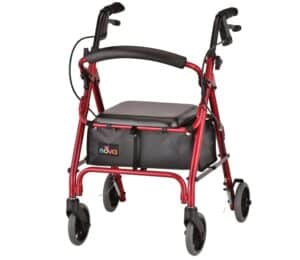
Many mobility impaired individuals use rollators to get around while traveling.
My wife is mobility impaired. She uses a rollater to help her get around. Rollators are mobile walking aids with three or four big wheels, hand-operated brakes that can be locked and a build-in seat with a large under-seat pouch. Her rollator is equipped with a special holder for her cane. She chose a narrow model that can be used to help her easily walk down the aisle of all Amtrak train cars, as well as most wide-body aircraft and some narrow-body planes.
Amtrak Acela trains are well designed to accommodate mobility impaired travelers.
About 10 minutes before boarding, we went down to the train platform. The Acela cars are all equipped with small ramps that automatically deploy to cover the gap between the train platform and the train car door. My wife was able to easily board the train and proceed to our business class seats.
Once she was in her seat, I folded her rollator, locked it, and stowed it for safety in the luggage area on the floor. The Acela was comfortable and spotless. The bathroom was also clean and easy to use for anyone with a disability. The trip to Washington DC proceeded without problem.
As we approached Washington, I retrieved and unfolded the rollator. My wife got up, stowed her belongings in the rollator pouch and when the train reached the station we departed. We walked together down the platform into the station, then out to the Massachusetts Avenue exit, where we were picked up to spend the day with two of our kids.
Amtrak makes many promises to provide accessible travel services.
Amtrak devotes a considerable amount of space on their website about Accessible Travel Services. They state,
“Our goal is to provide safe, efficient and comfortable service to all of our passengers. We are pleased to provide additional services to customers with disabilities, and we have worked to make our facilities more accessible to customers with disabilities.”
Amtrak states concerning Boarding & Detraining,
“Amtrak will provide assistance to customers with a disability who use a wheeled mobility device in the following situations:
• High Platforms: Amtrak will assist you across the gap between the platform and the train by using a bridge plate.
• Low-Level Platforms: Amtrak will provide access to the train through the use of station-based mobile lifts.”
We’ve been to Union Station many times over the years and found that Amtrak’s description about accessibility there, where it states that their platforms are accessible has been accurate each time we’ve been to the station. Like Philadelphia, for mobility disabilities, there are locations in Union Station where disabled passengers need to use an elevator to get to the station’s platforms.
Amtrak has formally stated that ADA serves as the foundation to the planning and work across their national network.
In July, 2022 at Amtrak’s celebration of the 32nd anniversary of the Americans with Disabilities Act, Amtrak’s CEO Stephen Gardner statement read, in part,
“For Amtrak, the ADA serves as the foundation to the planning and work being done across the organization and national network to ensure passengers with disabilities have access to stations, trains, and services. With input from the disability community, including national disability organizations, Amtrak advances a robust accessibility program and holistic approach to improve the travel experience – from trip planning, to purchasing tickets and the experience at stations, to equipment and on-board services.”
Unfortunately, at least in our case, on the Northeast Region train from Washington to Philadelphia, Amtrak’s words didn’t match their actions.
Amtrak failed us on our Northeast Regional for our return to Philadelphia. We were on the Northest Regional, in business class, because our original ticketed return on Acela was canceled due to a “schedule” problem. Being mobility disabled isn’t easy, but disabled people aren’t looking for easy, they are looking for reasonable accessibility so they aren’t shut out from enjoying life as much as everyone else.
Soon after we arrived at Union station, our gate number was listed. We immediately headed for the gate. When we arrived a few minutes later, many passengers were already in the standard line. We proceeded to the line for seniors and disabled passengers, then waited.
The gate agent at our Union Station gate never warned us that our train was not at an accessible train platform and failed to offer my wife any assistance or direct her to assistance.
Just prior to boarding, an Amtrak gate agent arrived. He immediately allowed our line to start moving to the train platform. He showed my wife and I where the elevator to the platform was located. He didn’t need to accompany us on it and didn’t do so. He never told us our train platform wasn’t accessible or offer to get us help, clearly seeing my wife using a rollator. Having gone down the elevator, we arrived at the train platform.
We were immediately dismayed. The platform was deserted and it wasn’t accessible.
An Amtrak employee ignored our request for help boarding our train.
We walked toward the front of the train and asked an Amtrak employee if we were on the right platform. He said we were, then ignored our request for help boarding. It was well after dusk and the platform was poorly lighted.
The lighting on the train platform was so dim that we could barely see our train and were fearful for our safety.
By the time we got to the front of the train it appeared that all the platform lights were out. We felt highly concerned for our safety.
She had to climb the stairs with her cane and a difficult assisting lift from me since Amtrak provided no required ADA required accommodation. She was left on her own, ignored by Amtrak.
I walked back toward the terminal looking for help, while my wife stayed near our train car. Only passengers were on the platform. Despite my surgically repaired back, I helped her up the difficult steps into the train car where she used her cane and the handrails, with me holding and pushing her from behind. Once she was on the train, I had no choice but to lift her rollator (almost 20 pounds) on to the train, then climbed up the steps myself, with my backpack.
Once in the business car of the Northeast Regional, we found it dimly lighted and filthy.
This was the business car of the Northeast Regional. It was dimly lighted and filthy. The lavatory looked as though it hadn’t been cleaned in days. We found our seats and I put the rollator in the luggage area. When the conductor scanned our tickets and heard our story, she apologized. While I was appreciative of the apology it didn’t make up for the difficulties they put my wife through to get on to this filthy train car, nor my now sore back.
To add “insult to injury” we arrived in Philadelphia late.
The ride to Philadelphia was generally uneventful, except that we were late.
Amtrak’s ADA actions must live up to their ADA promises.
Amtrak’s promise that the ADA serves as their foundation was not met this past weekend at Union Station. The Amtrak employee we asked for help turned away. We were on our own and that should not have been true. Amtrak needs to investigate their ADA compliance, then turn their promises into renewed action. It should never fall on mobility disabled people to have to interrogate Amtrak personnel to find out when, where and if they can supply needed help when requested. Every Amtrak station should be ADA accessible in all locations, at all times.
I will be reaching out to Amtrak’s headquarters this week about the situation and fill you in with whatever they say.

After many years working in corporate America as a chemical engineer, executive and eventually CFO of a multinational manufacturer, Ned founded a tech consulting company and later restarted NSL Photography, his photography business. Before entering the corporate world, Ned worked as a Public Health Engineer for the Philadelphia Department of Public Health. As a well known corporate, travel and wildlife photographer, Ned travels the world writing about travel and photography, as well as running photography workshops, seminars and photowalks. Visit Ned’s Photography Blog and Galleries.

Without commenting on Amtrak, I can say an ultralight x frame rollator would make this travel experience significantly better compared to the a frame model shown (sold to Americans but nobody else). Center folding for tight space. 1/2 weight lifting up the steps. Real tires for urban sidewalks. Carbon fiber or aluminum. Costs more. Worth it.